

OpenAI now offers Zero Data Retention on its frontier models — removing the single biggest reason many teams refused to touch AI. Here's what it actually means.
For two years, one objection has quietly killed more enterprise AI projects than any budget review: "We can't send that to a model provider — we don't know where it goes."
Legal wouldn't sign off. Security flagged it. The pilot died in a meeting. So people used the tools anyway, on the sly, pasting contracts and code into whatever chatbot was open in another tab. The concern was never irrational — it was just unaddressed.
This week, OpenAI addressed it head-on: Zero Data Retention (ZDR) for frontier models, alongside a new Private Safety Processing system. Together they change the answer to "where does our data go?" from a shrug to a contractual commitment. If your organization has been sitting on the sidelines, the reason you were sitting there just got smaller.
What actually changed
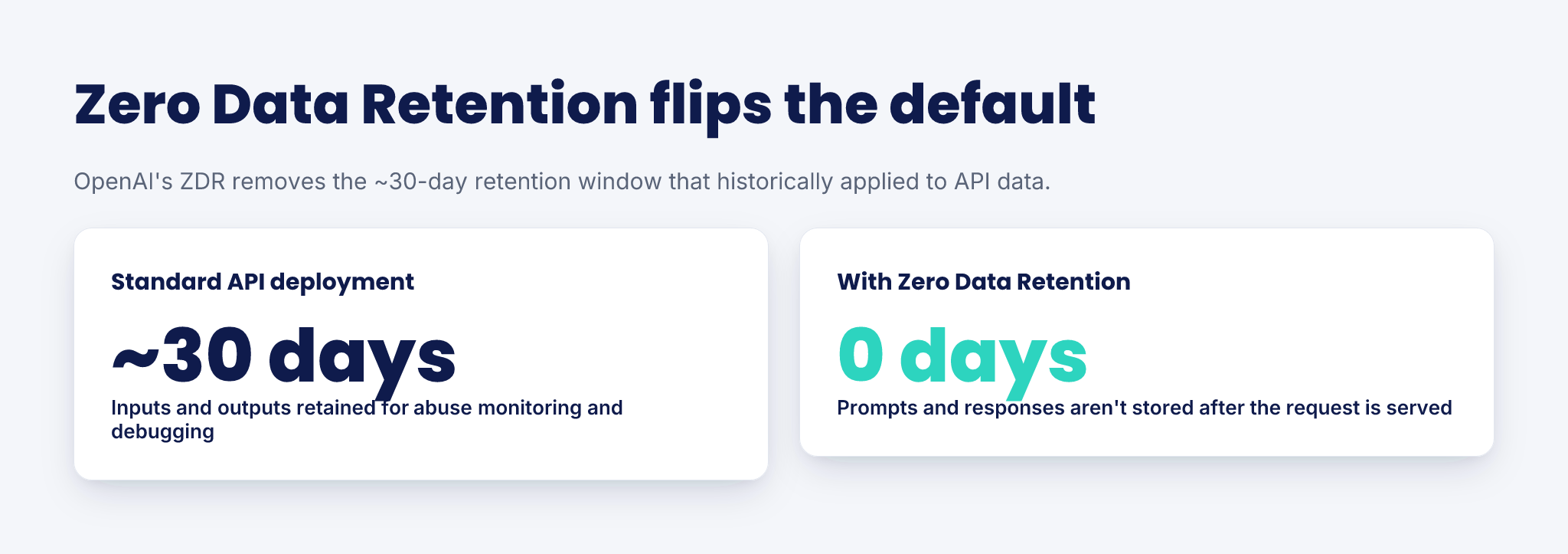
Under a standard API deployment, providers have historically retained inputs and outputs for a period of time — often around 30 days — for abuse monitoring and debugging. Reasonable, but a dealbreaker for regulated data, privileged material, or anything under strict client confidentiality.
- Zero Data Retention flips that default. With ZDR enabled, your prompts and the model's responses aren't stored after the request is served. No 30-day window. No logs sitting on someone else's disk waiting to become a breach headline. The data is processed and gone.
- Private Safety Processing is the clever part that makes ZDR viable. Providers still have to screen for abuse and legally-mandated harms — you can't just turn off safety because a customer wants privacy. Private Safety Processing runs those checks in a way that doesn't require a human-readable copy of your content to be retained. It's an attempt to have both: real safety enforcement and real confidentiality.
Read the asterisk
Here's the honest caveat, because it matters. ZDR is not literally "nothing is ever kept."
OpenAI notes that content flagged as potential child sexual abuse material (CSAM) is still retained for manual review and mandatory reporting — as it is legally required to be, like every frontier provider. That is the correct policy, and it is not a loophole you should be worried about for legitimate business use. But it means the marketing phrase "zero retention" has an ethical, legal floor beneath it.
The practical takeaway: ZDR is a strong, specific control — not a magic invisibility cloak. Treat it as what it is. A meaningful reduction in retention risk, not the elimination of every obligation you have around the data you're feeding in.
Why this is bigger than one feature
Step back and this is part of a pattern. Frontier labs are competing not just on how smart the model is, but on how deployable it is inside a serious organization. Zero retention. Enterprise controls. Regional processing. Audit trails. The center of gravity is shifting from "look what it can do" to "here's how you can actually run it without your CISO having a panic attack."
That's good news. It means the gap between "consumer AI you shouldn't trust with real data" and "enterprise AI you can" is finally widening in a legible way. The tools are meeting organizations where their risk teams live.
But it also creates a new problem: you now have to know which of your AI usage runs under these controls and which doesn't.
The question ZDR forces you to answer
Zero Data Retention only protects the data that flows through the deployment where it's enabled. It does nothing for:
- The employee using a personal ChatGPT account on the free tier
- The third-party SaaS tool that quietly embeds a model and retains everything under its terms
- The internal app someone wired up six months ago with default settings
- The vendor running AI on your behalf whose retention policy you've never read
In other words, a great data-retention control is only as good as your knowledge of where your AI actually lives. If you can't list every system, model, and vendor touching your data, you can't say which ones honor ZDR — and "we turned on zero retention" becomes a comforting sentence that's technically true and operationally meaningless.
This is exactly the inventory problem. You can't apply a control to systems you haven't catalogued. The moment a provider offers a real privacy guarantee, the bottleneck moves from "does a good option exist?" to "do we know where to apply it?"
What to do this week
- Inventory first. Map which AI systems process sensitive data, who owns them, and what each one's retention terms actually say — not what you assume they say.
- Enable ZDR where it fits. For deployments handling regulated, privileged, or confidential data, turn it on and document it. It's a fast win.
- Read your vendors' asterisks. Every "we don't retain data" claim has a footnote. Know what stays and why.
- Close the shadow gap. ZDR on your official deployment doesn't help if half your team is still using unmanaged tools. Give people a sanctioned option that's genuinely safer, then make it the easy path.
The old excuse — "we can't use AI because of where the data goes" — is expiring. That's a win. But it quietly hands you a harder question in return: do you actually know where all your data is going in the first place?
Answer that, and Zero Data Retention becomes a real safeguard. Skip it, and it's just a checkbox on one deployment while the risk keeps flowing everywhere else.