

Your company has an AI policy — approved tools, training, a one-pager. Meanwhile, employees paste client contracts and code into AI tools IT never reviewed.
That's shadow AI, and it's already inside your organization.
What Is Shadow AI?
Shadow AI is the use of AI tools, applications, and browser extensions by employees without the knowledge, review, or approval of IT and security teams. It's the AI-era version of shadow IT — the old problem of employees signing up for unauthorized Dropbox accounts or forwarding work email to personal Gmail — except the stakes are considerably higher.
Shadow IT meant unmanaged storage. Shadow AI means an outside system is actively processing, transforming, and potentially retaining your company's most sensitive information. When someone pastes a customer list into a free chatbot to draft a follow-up email, or feeds proprietary code into an AI assistant to debug it, that data leaves your perimeter and enters a third party's pipeline — often with no contract, no data processing agreement, and no visibility for the people whose job it is to protect that information.
Shadow AI shows up differently across departments. Sales reps run prospect and pricing data through unauthorized tools to draft outreach. Engineers paste proprietary code into AI coding assistants for debugging help. HR teams run candidate information through resume screeners with no data agreement in place. Finance analysts drop unreleased earnings figures into a chatbot to build a summary. Legal teams use consumer-grade tools to review contract language, unaware that doing so may waive privilege. Different departments, same underlying pattern: useful tools, unclear rules, and sensitive data moving outside every system built to protect it.
Why Shadow AI Is Growing So Fast
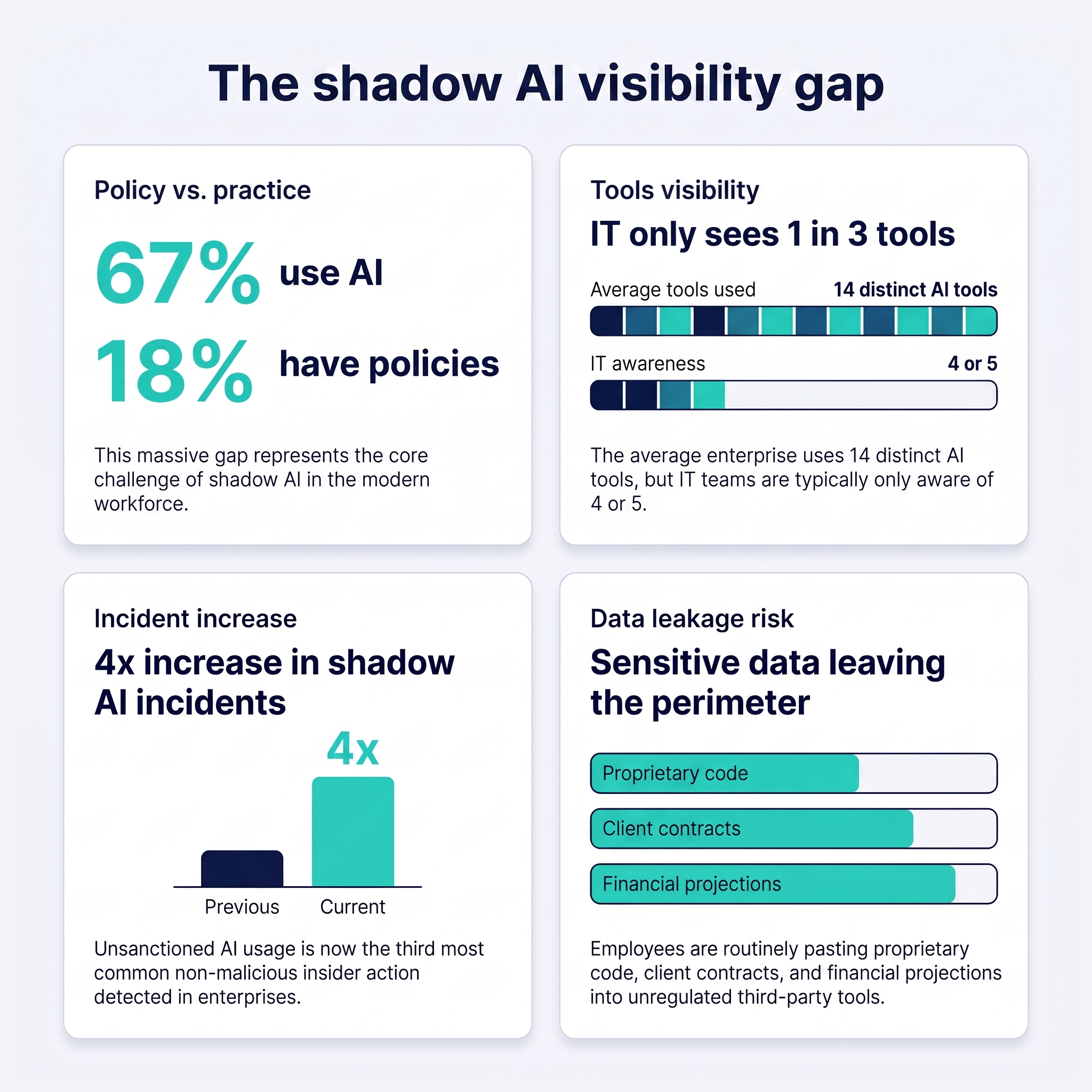
Shadow AI isn't a fringe behavior anymore — it's close to universal. Salesforce's 2026 Workforce AI Survey found that 67% of employees now use AI tools at work, while only 18% of organizations have formal AI security policies in place. That gap — most of the workforce using AI, a small fraction of companies actually governing it — is the entire shadow AI problem in one statistic.
It's not because employees are being reckless. It's because approved channels are usually slower than the alternative. If the sanctioned AI tool requires a procurement cycle and a security review, and the unsanctioned one is a free sign-up away, most employees under deadline pressure will take the free sign-up. Blocking access outright rarely solves this either — it tends to push the same behavior further out of view rather than eliminating it.
The scale of the resulting sprawl is easy to underestimate. According to Productiv's 2026 analysis, the average enterprise has 14 distinct AI tools in active use, of which the IT team is aware of only 4 or 5. That means for every AI tool your organization has reviewed and approved, roughly two more are running unchecked — each one a potential point of data exposure, and none of them accounted for in your risk register, your vendor inventory, or your incident response plan.
And the trend line is moving the wrong way. Verizon's 2026 Data Breach Investigations Report found that shadow AI has become the third most common non-malicious insider action detected in enterprise environments — a fourfold increase from the previous year. This isn't a slow-building risk. It's compounding, year over year, faster than most governance programs are built to handle.
Why This Should Worry Your CIO Specifically
Shadow AI lands squarely on the CIO's desk for a few reasons, and none of them are hypothetical.
You can't secure what you can't see. Traditional security tooling — firewalls, endpoint detection, DLP — was built around known systems and sanctioned data flows. Shadow AI tools frequently connect via browser extensions, personal accounts, or API keys that never touch a security review. Every one of those connections is a supply-chain dependency your security team doesn't know exists. It creates regulatory exposure without a paper trail. If a shadow AI tool processes personal data, health information, or financial records, your company may be out of compliance with GDPR, HIPAA, or sector-specific rules — and you won't find out until an audit, a breach, or a regulator asks. There's no data processing agreement to point to, because no one approved the tool in the first place. It undermines the governance program you've already built. Many organizations have invested real time in an AI policy, an approved-tools list, and a training program — only to have a majority of actual AI usage happen entirely outside that structure. A governance program that only covers the AI you know about isn't really governing your AI risk; it's governing a fraction of it. It's now a board-level question. As AI incidents involving unauthorized tools make headlines, boards are increasingly asking CIOs a direct question: do we actually know what AI tools our employees are using, and what data is going into them? "We have a policy" is no longer a sufficient answer if there's no visibility behind it.What This Looks Like at a Mid-Market Company
Picture a 400-person logistics company. IT has approved one AI tool: a licensed version of an AI writing assistant for the marketing team. That's the entire "AI program" on paper.
In practice, the operations team has been using a free AI tool to summarize vendor contracts for months, because reading them manually took too long. A sales manager built a habit of pasting deal notes and pricing history into a chatbot to draft renewal emails faster. A developer on the small internal tools team connected an AI coding assistant directly to a repository containing customer integration code, because it made his sprints faster and no one told him not to.
None of this was malicious. Each person solved a real problem with a tool that was free, fast, and already familiar from home. But now customer contract terms, live pricing strategy, and proprietary integration code are sitting inside AI providers the company has no agreement with, no visibility into, and no way to audit if a customer ever asks how their data has been handled.
This is what makes shadow AI a mid-market problem specifically, not just an enterprise one. Larger companies at least have dedicated security teams running periodic audits. Mid-market IT teams are often stretched across everything from help desk tickets to vendor contracts, with no bandwidth left to hunt down AI tools nobody asked them to review. The exposure is often just as real — sometimes more so — but there's far less capacity to catch it.
How to Get Ahead of Shadow AI
The instinct to ban unauthorized tools outright is understandable, but it rarely works — it drives usage further underground rather than eliminating it. A more durable approach starts with visibility, not enforcement.
- Run a visibility audit. Before writing new policy, find out what's actually happening. Network traffic analysis, SSO and OAuth logs, expense reports, and browser extension audits will surface AI tools your team doesn't yet know about.
- Build a real AI systems inventory. A policy is only as good as the inventory behind it. You need a living record of every AI tool in use across the organization — sanctioned and unsanctioned — along with what data flows into it and who owns that risk.
- Give people a faster approved path. Shadow AI thrives when the sanctioned alternative is slower or less capable than the unsanctioned one. Closing that gap — not just publishing a policy — is what actually changes behavior.
- Classify by risk, not by tool. Not all shadow AI use carries the same exposure. An AI tool summarizing public information is a different risk than one processing customer PII or unreleased financials. Your governance effort should scale with the sensitivity of the data involved.
- Make this an ongoing practice, not a one-time project. New AI tools launch constantly, and usage patterns shift just as fast. Static audits go stale within a quarter. Shadow AI needs continuous visibility, not a point-in-time assessment.
Shadow AI: Quick Answers
Is shadow AI illegal? Not inherently. It becomes a legal problem when the data involved is regulated — customer PII, health records, financial data — and the tool processing it has no compliance agreement with your company. Is shadow AI the same as an AI security breach? No, but it raises the odds of one. A tool your security team has never reviewed is, by definition, untested against your data protection standards. Should we just ban unauthorized AI tools? Outright bans tend to push usage further out of sight rather than ending it. Most organizations get further by pairing clear policy with a faster, better-supported approved path. Where should we start? With visibility. You can't govern, secure, or set policy around AI tools you don't know exist. An inventory of what's actually in use comes before any other governance step.Visibility Is the Starting Point, Not the End Goal
The organizations getting ahead of shadow AI aren't the ones with the strictest bans — they're the ones with the clearest visibility. Knowing which tools are in use, what data is flowing through them, and who's accountable for that risk is the foundation every other governance decision rests on.
That's the gap Evum is built to close. Instead of chasing shadow AI department by department with spreadsheets and surveys, Evum gives you a continuously updated inventory of every AI system in your organization — sanctioned and unsanctioned — so your governance program is built on what's actually happening, not what's on the approved-tools list.
See how Evum maps your organization's AI footprint at evum.ai