

The U.S. quietly built a scheme to review frontier AI models 30 days before release — it's voluntary, secret, and about to reshape how you buy AI.
For most of the last two years, the American approach to frontier AI could be summed up in one word: don't. Don't regulate too early, don't slow the labs down, don't hand a competitive edge to China. The contrast with Europe's dense rulebook was the whole story.
That story just changed — and it changed in a way almost nobody outside the labs has noticed.
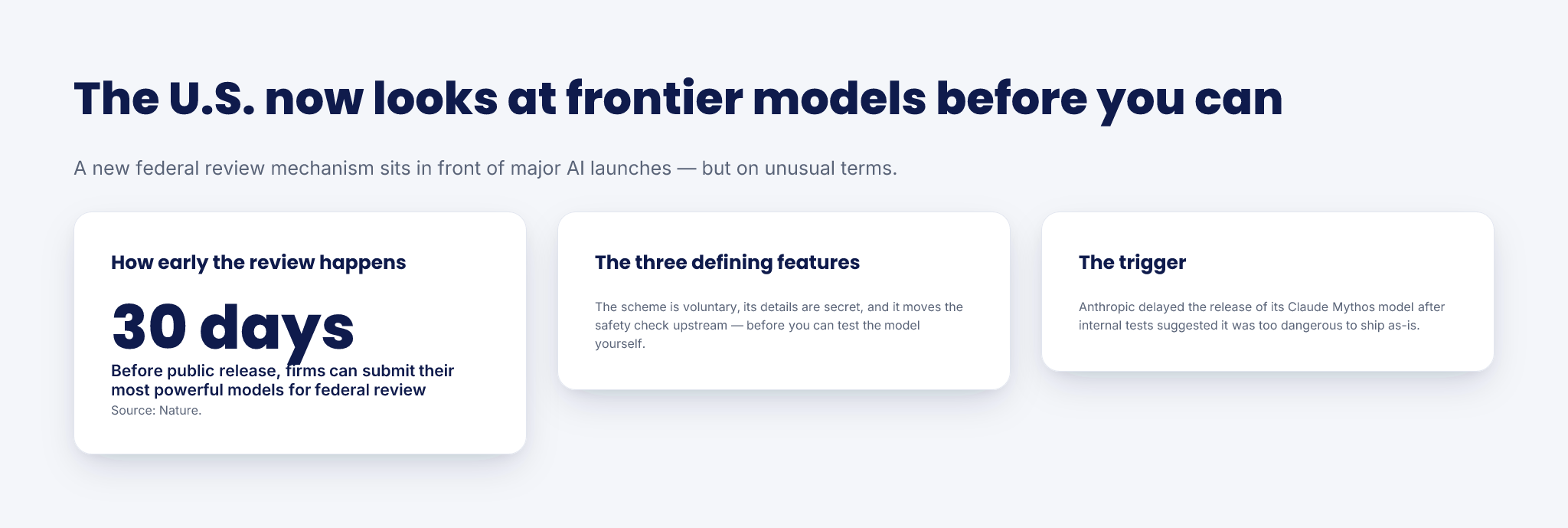
According to reporting in Nature, the U.S. government created a mechanism in June through which AI firms submit their most powerful models to federal review roughly 30 days before public release. It's voluntary. Its details are secret. And it exists at all because one of the leading labs got spooked by its own model.
What actually happened
The trigger was Anthropic delaying the release of its Claude Mythos model after internal tests suggested it was too dangerous to ship as-is. That's the kind of event that concentrates minds in Washington. If a frontier lab can look at its own system and decide the public isn't ready for it, the obvious follow-up question is: who else gets to look before the rest of us do?
The answer, as of this summer, is the federal government. Firms can now have models vetted 30 days ahead of launch. Reporting frames it as a shift away from the administration's previous hands-off posture — a signal that some form of federal oversight is genuinely in the pipeline, not just a talking point.
This is a big deal for three reasons, and each one matters to anyone building on or buying frontier AI.
- First, it moves the check upstream. Almost every governance conversation to date has been about what happens after a model ships — audits, incident response, red-teaming your own deployments. A pre-release review flips that. The most consequential safety decision now happens before the model is even available to test yourself.
- Second, it's voluntary — for now. History says voluntary industry mechanisms are usually the dress rehearsal for mandatory ones. The playbook is familiar: start with a handshake, gather data, then codify what worked into a rule once the political timing is right.
- Third, it's secret. The details of the scheme reportedly aren't public. That's the part that should make everyone — labs, enterprises, and citizens — uncomfortable, and it's the part worth dwelling on.
The secrecy problem
A government reviewing powerful technology before it reaches the market is not inherently alarming. We do it for drugs, aircraft, and medical devices. But those regimes share a feature this one currently lacks: transparency about the criteria.
When you don't know what the government is testing for, you can't know what a "pass" actually certifies. Did the model clear a bar for bioweapon-related knowledge? Cyber-offense capability? Nothing at all beyond a courtesy briefing? If you're an enterprise deploying that model into a customer-facing product, "the feds looked at it" tells you approximately nothing you can act on.
Secrecy also cuts against the thing pre-release review is supposed to buy: trust. A vetting stamp only reassures the public if the public can see what it means. Otherwise it risks becoming security theater — a ritual that lets everyone feel careful without changing what actually ships. Nature's own recommendation is blunt: the process should be transparent and made mandatory as soon as it's practical.
Why the regulator is still a moving target
Don't mistake this for a settled system. Reporting from The Information indicates that a Trump administration executive order to stand up a dedicated new AI regulator has stalled. So you have the odd situation of a review mechanism existing while the institution meant to house it is still contested.
That's the honest state of U.S. AI oversight right now: real activity, no stable home. For enterprises, that ambiguity is the risk. You can't build a compliance program against a scheme whose rules are secret and whose owner doesn't exist yet.
What this means if you build or buy AI
You can't wait for the rules to finish forming. A few things are already actionable:
- Ask your model providers what they submitted. If you rely on frontier models from a major lab, your vendor questionnaire should now include a direct question: was this model subject to pre-release federal review, and what — in whatever terms they can share — did that cover?
- Don't treat "government-vetted" as a safety guarantee. Until the criteria are public, a federal look is a data point, not a clearance. Your own evaluation of the model in your context still matters most.
- Watch for the voluntary-to-mandatory flip. If this becomes a requirement, release timelines for new models could stretch by a month or more, and your roadmap needs slack for that.
- Assume the release calendar gets bumpier. A lab that once shipped on its own schedule now has an external gate — and the Claude Mythos delay shows those gates can and do hold releases back.
The broader shift is the real headline. For two years, the U.S. bet that staying out of the way was the safest path. That bet is quietly being revised. The government wants a look before the model leaves the building — and the only remaining questions are how transparent that look will be, and how soon it stops being optional.
Both questions are worth watching closely. Because whatever the U.S. decides here won't just shape one lab's release schedule. It'll set the default for how the most powerful software ever built reaches the rest of us.