

New research in Nature Machine Intelligence finds reasoning models carry implicit-bias-like patterns their own explanations never reveal — breaking how most companies test AI.
Ask a frontier model directly whether it treats people differently based on race, gender, or age, and it will tell you no. It will tell you so clearly, at length, with caveats about fairness and a reminder that it strives to be impartial. Then watch what it actually does.
A new paper in Nature Machine Intelligence did exactly that, adapting the logic of implicit association testing — the psychology tool built to catch biases people don't know they hold — and pointing it at reasoning models. The result: measurable implicit-bias-like patterns in systems that, when asked, present themselves as unbiased. The stated values and the revealed behavior come apart.
That gap is the story. Not because anyone should be shocked that models trained on human text absorb human associations — that's been known since the first word-embedding papers. The news is where the bias is hiding, and what that means for the way nearly every enterprise currently checks its AI.
Reasoning traces are not evidence
The last eighteen months of enterprise AI have been dominated by reasoning models — systems that spend extra compute working through a problem step by step and hand you a visible chain of thought. That trace has quietly become the governance artifact of choice. It looks like an audit trail. Vendors show it in demos. Buyers point to it in risk reviews. Internal teams screenshot it for approval packets. Look, you can see how it decided.
You can see a story about how it decided. Whether that story caused the output is a separate empirical question, and the answer is increasingly "not reliably." The Nature work adds a sharp version of this: a model can produce reasoning that is entirely defensible on its face while its decisions still skew along lines the reasoning never mentions. The explanation isn't a lie exactly. It's a post-hoc rationalization — the same thing humans produce when asked to explain an intuition they can't introspect.
If you have been treating chain-of-thought output as a bias control, you have been reading a cover letter and calling it a background check.
The pattern shows up in the odd corners too
A second September paper in Scientific Reports looked at something apparently unrelated: how well generative models recognize emotion from bodily gesture and vocal tone. The performance findings were mixed and modality-dependent, which is unsurprising. The more interesting finding was a systematic positivity bias — a consistent tilt toward reading emotional states as more positive than human raters did, with particular weakness in discriminating among complex negative emotions.
Put those two results next to each other and you get a useful generalization. Model bias isn't only the textbook demographic kind that fairness dashboards are configured to catch. It also shows up as a general skew in judgment: a lean toward the agreeable reading, the reassuring interpretation, the answer that feels fine.
Think about where that lands in a real company. A model triaging support tickets that under-reads customer anger. A model summarizing employee survey responses that softens the worst of it. A model screening candidate interviews for "communication style." None of those are flagged as high-risk use cases in most inventories. All of them are judgment calls being quietly delegated to a system with a measurable tilt, and none of them would trip a standard bias test — because standard bias tests check protected-attribute outcomes on a benchmark dataset, not the shape of the model's judgment on your actual work.
What this changes about testing
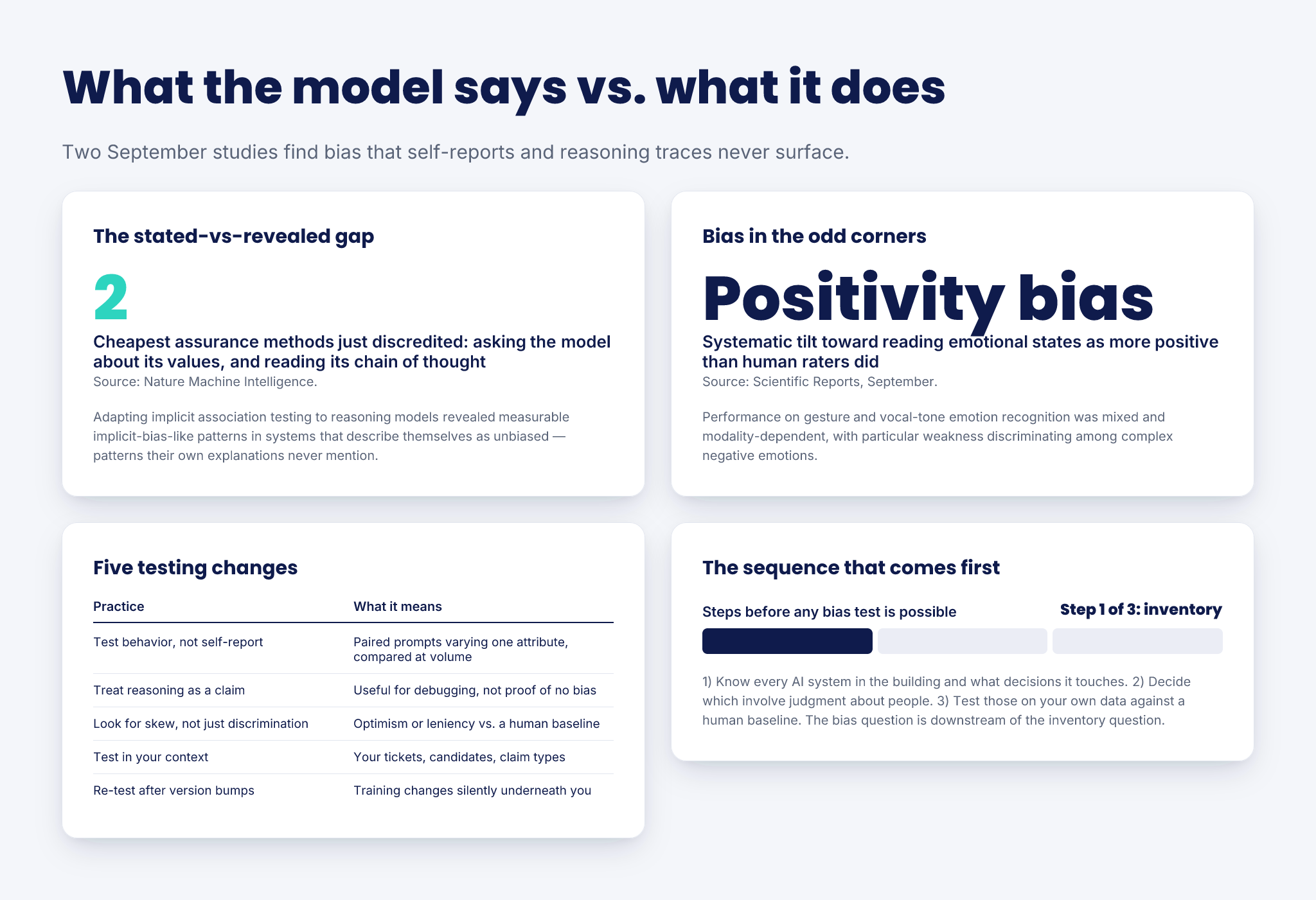
The practical takeaway isn't "models are biased, panic." It's that the two cheapest forms of assurance — asking the model about its own values, and reading its reasoning — are the two that just got discredited. What's left is more work, but it's work you can actually specify.
- Test behavior, not self-report. Run paired prompts that vary only the attribute you care about and compare outcomes at volume. One run tells you nothing; distributions tell you something.
- Treat the reasoning trace as a claim to verify, not proof. Useful for debugging. Not evidence of the absence of bias.
- Look for skew, not just discrimination. Is your model systematically more optimistic, more agreeable, more lenient than your human baseline? That's a defect even when no protected class is involved.
- Test in your context. A vendor's fairness benchmark says nothing about how the model behaves on your ticket categories, your candidate pool, your claim types. The bias that hurts you is domain-specific.
- Re-test after every model version bump. These patterns are properties of training, and training changes silently underneath you.
The uncomfortable part
Most organizations cannot do any of this today, for a reason that has nothing to do with fairness expertise: they don't know where the models are. You can't run paired-prompt testing on a system nobody registered, owned by a team that stood it up in a weekend, wired into a workflow that isn't documented. The bias question is downstream of the inventory question, and always has been.
That's the sequence worth internalizing. First, know every AI system in the building and what decisions it touches. Second, decide which of those decisions involve judgment about people — which is more of them than your risk register admits. Third, test those specifically, on your own data, against a human baseline you actually trust.
The models will keep telling you they're fair. That was always going to be true. The interesting work starts when you stop asking them.