

OpenAI has published its clearest statement yet that automating its own research is the core strategy — and that frontier models think in ways humans shouldn't expect to recognize.
Most lab communications are product news. Occasionally a lab publishes something closer to a declaration of intent. OpenAI just did both at once: an essay titled "An Alien Mind," paired with a companion piece on research acceleration written from inside the organization. Read together, they say two things that matter to anyone planning an AI roadmap.
The first: recursive self-improvement — AI systems playing a growing role in developing the next AI systems — is not a speculative side quest at OpenAI. It is described as the organizing priority. In the company's own framing, machine RSI "will be at the very core of future scientific discovery," and the lab is directing research toward it because it believes that's the only way to stay at the frontier.
The second is stranger and, I'd argue, more useful. The "alien mind" framing is an admission that these systems are not small humans, not digital colleagues, and not reliably interpretable by analogy to how you think. They are optimization artifacts with capability profiles that spike and crater in places no human's would. That's not marketing. It's a warning label written by the manufacturer.
Why the RSI declaration changes your planning horizon
There's a reasonable instinct to file "AI improving AI" under sci-fi and move on. Resist it, because the practical consequence is mundane and immediate: it's a statement about the rate of change in the infrastructure you're buying.
If the labs succeed even partially at compressing their own research loops, model generations arrive faster, capability jumps get less predictable, and the shelf life of any given evaluation shrinks. If they fail, you get roughly today's cadence — which is already fast enough to break most annual planning cycles.
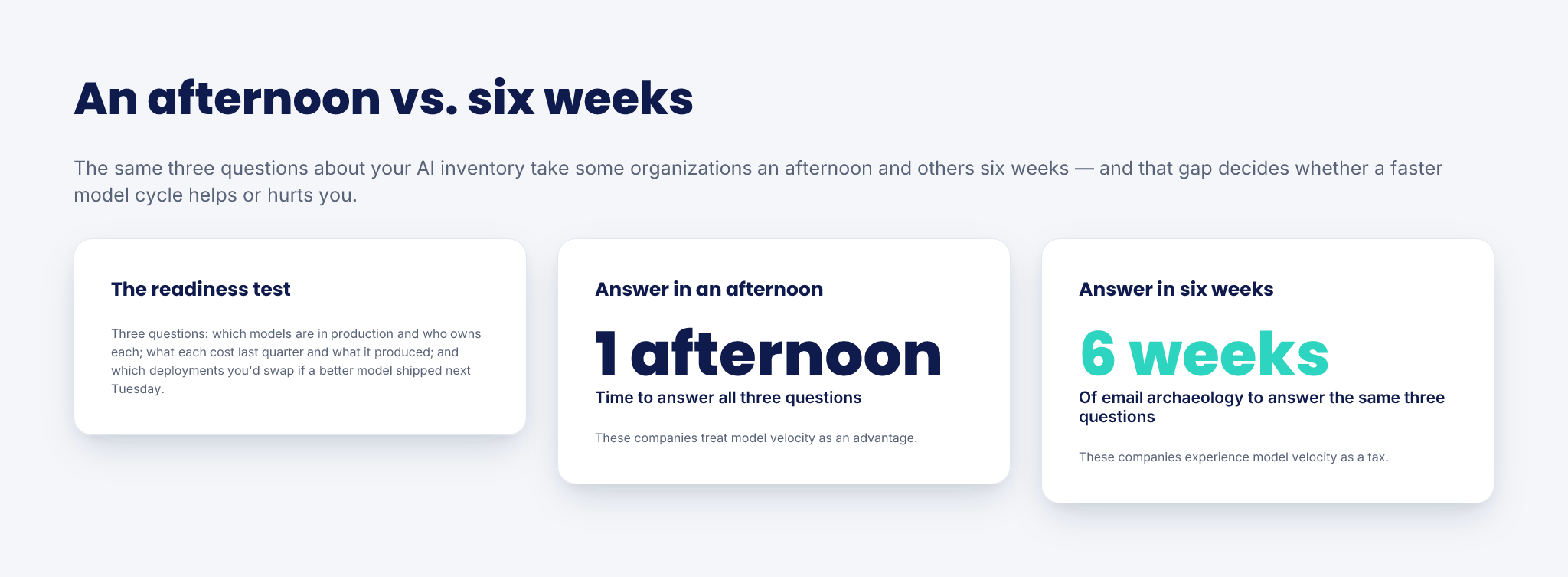
Either way, the correct posture is the same, and most organizations aren't in it. A useful sanity check: how long would it take your company to answer these three questions?
- Which models and vendors are currently embedded in production systems, and who owns each one?
- What did each of those systems cost last quarter, and what did it produce?
- If a materially better model shipped next Tuesday, which of your deployments would you swap, and how long would the swap take?
Companies that can answer in an afternoon treat model velocity as an advantage. Companies that need six weeks of email archaeology experience it as a tax.
The "alien mind" point is the practical one
The essay's more interesting contribution is epistemic humility about what's inside these systems. Anthropomorphizing models is the single most expensive habit in enterprise AI. It leads teams to assume that a system which writes a flawless legal summary must also understand that it shouldn't email that summary to an external party — because a competent human would understand both. Capability in one dimension gets read as judgment across all of them.
That assumption is wrong, and "alien mind" is a decent mnemonic for why. The capability surface is jagged. A model can produce research-grade mathematics and then fail a task a careful intern would handle, and there is no intuitive rule that tells you in advance which is which. Recent work outside the labs reinforces the point from a different direction: reasoning models have been shown to exhibit implicit-bias-like patterns in their outputs, the kind of structured distortion you'd never find by asking the model whether it was biased.
The operational takeaway isn't fear. It's that you cannot infer performance on your task from performance on someone else's benchmark. You have to test the thing you actually intend to do, on your own data, with your own failure definitions — and then re-test when the model changes underneath you.
What to actually do about it
Three moves separate the organizations that will handle an accelerating frontier from the ones that will be handled by it.
- Build the inventory before you need it. Every argument for moving fast on new models assumes you know what you're currently running. Most companies don't. Not because they're careless, but because AI adoption arrives sideways — through a product team's API key, a SaaS vendor's feature update, a department's expensed subscription. If a faster model cycle is coming, an accurate map of what you have is the prerequisite for exploiting it.
- Make evaluation a standing capability, not a launch gate. If you tested a system once at deployment and never again, you tested a model that may no longer exist. Providers update, route requests differently, deprecate versions. The teams that will benefit from rapid model improvement are the ones that can run a regression suite over their real use cases in hours.
- Tie spend to observed value, per system. RSI narratives push in the direction of buying more, faster. The corrective is knowing which of your AI systems is producing measurable value and which is a pilot that quietly became permanent. That's not conservatism — it's what lets you fund the next thing without asking for a bigger budget.
There's a version of this news that reads as hype, and a version that reads as a genuinely useful signal. I think it's the second. A frontier lab telling you its central bet is on compressing its own research cycle, while simultaneously telling you not to assume you understand how its models think, is giving you two concrete pieces of planning information.
Assume the ground moves faster than your procurement cycle. Assume you don't get to reason about these systems by analogy to people. Build for both, and the pace of the frontier becomes something you can use rather than something that keeps happening to you.