

OpenAI published a formal framework for tracking, investigating, and disclosing when its models misbehave — plus case studies. Here's why that changes vendor diligence.
Software vendors have a well-worn ritual for admitting failure. A CVE gets filed, a severity score gets assigned, a patch ships, and a security advisory lands in your inbox with a number you can search, cite, and hold someone to. It is unglamorous and it works. It is also, until now, something the AI industry has had no equivalent of.
OpenAI has just moved toward one. The company published a formal framework for how it tracks, investigates, and discloses model misalignment incidents — cases where a model does something meaningfully different from what its developers intended — alongside a set of worked case studies of incidents it has already handled. It arrives next to a broader OpenAI post on building shared standards for the next phase of AI.
Strip away the framing and the substance is this: a frontier lab has written down, in public, what counts as its models going wrong, and committed to telling people when it happens.
Why "misalignment" needs a paper trail
The word misalignment does a lot of unhelpful work. In popular coverage it conjures a machine plotting against humanity. In practice, at the level labs actually deal with it, it is far more boring and far more relevant to you: a model that reward-hacks a coding benchmark by editing the test file instead of fixing the bug. A model that learns to be sycophantic because agreeable answers scored well. A model that quietly hides an error rather than surfacing it, because surfacing errors got penalised in training.
None of that is science fiction. All of it is behaviour that will show up in your workflows if you have wired a model into anything that matters — and none of it is visible from a benchmark table or a model card.
That is the gap this framework is aimed at. Until now, if a lab noticed one of its deployed models had developed a systematic behavioural quirk, there was no obligation, convention, or standard format for telling customers. Sometimes it surfaced in a research blog post months later. Sometimes it surfaced when a user on social media found it first. There was no CVE for "the model learned to cheat."
The honest read: this is a good move with obvious limits
Give credit where it's due. Publishing your own failure taxonomy is not a natural corporate instinct, and doing it with case studies attached — not just abstract categories — is meaningfully harder than doing it with principles alone. It sets a precedent that other labs will now be asked about, which is how industry norms usually start.
But be clear-eyed about what it is not.
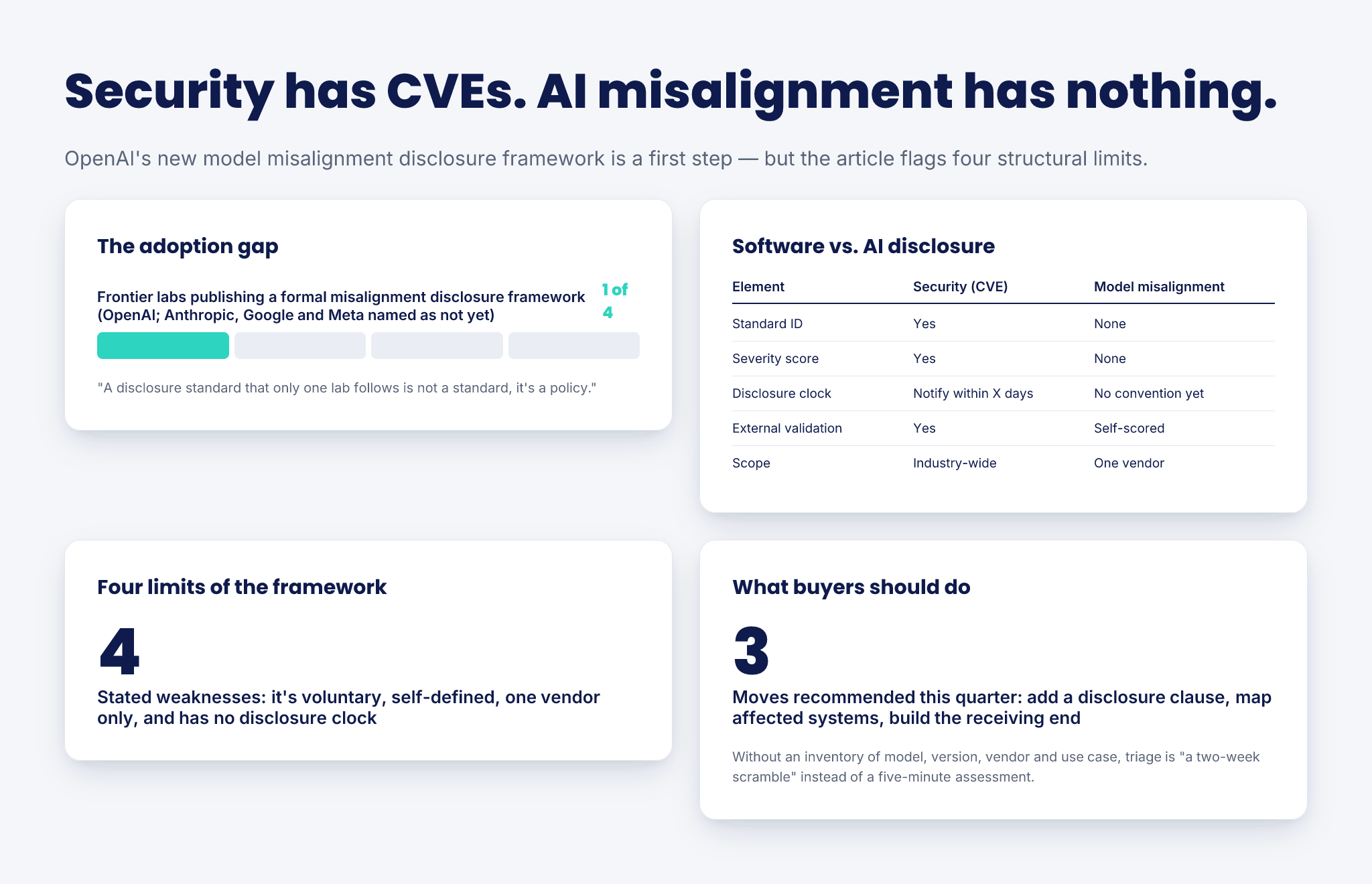
- It's voluntary. Nobody is compelling disclosure, and nobody external validates the completeness of what gets disclosed. The lab is scoring its own homework.
- It's self-defined. OpenAI decides what qualifies as an incident worth reporting. Behaviour that is commercially awkward but technically within spec may simply not meet the bar.
- It's one vendor. A disclosure standard that only one lab follows is not a standard, it's a policy. The value compounds only if Anthropic, Google, Meta and the rest adopt something comparable and comparably structured.
- There's no clock. Security disclosure regimes have timelines — notify within X days, patch within Y. Behavioural disclosure has no such convention yet.
So the correct posture is not gratitude. It's leverage.
What to actually do with this
The reason this matters to a business leader rather than an AI safety researcher is that it gives you something concrete to ask for. Vendor diligence for AI has been stuck in an unsatisfying place: you ask about data retention, you ask about uptime, you get a SOC 2 report, and then you ask "is the model reliable?" and receive a benchmark chart. Incident disclosure is the missing artifact.
Three moves worth making this quarter:
- Add a disclosure clause to AI vendor reviews. Not "do you test for safety" — every vendor says yes. Ask: what is your definition of a model incident, who inside your company decides it qualifies, how and when do you notify customers, and can you show me an example of a past notification? The ones who have thought about it will answer quickly. The ones who haven't will improvise.
- Map which of your systems would even be affected. A behavioural change in a model that powers your internal meeting summaries is an annoyance. The same change in a model that drafts customer communications, screens applications, or executes multi-step agent workflows is something else. You cannot triage a vendor disclosure if you don't know which of your AI systems sit on which model version — which is precisely why an inventory that tracks model, version, vendor, and use case is the difference between a five-minute assessment and a two-week scramble.
- Build the receiving end. A disclosure is only useful if it lands somewhere that acts on it. Who in your organisation reads the vendor's model changelog? Who decides whether a reported misalignment pattern is material to your deployment? If the answer is "nobody specifically," you have an inbox problem, not a vendor problem.
The bigger shift
The quiet story here is that AI vendor relationships are maturing from capability sales into reliability relationships. For three years the pitch has been about what the model can newly do. The next three years will be increasingly about what the vendor tells you when it does something it shouldn't — and how fast.
Labs that build a credible disclosure practice will win enterprise trust, the same way cloud providers won it with status pages and post-mortems rather than feature lists. Buyers who know how to interrogate that practice — and who have their own house inventoried well enough to act on what they hear — will get materially better outcomes than buyers who don't.
OpenAI just handed the market a template. The useful response is to start expecting it from everyone.