

OpenAI is putting advertising inside ChatGPT — turning the assistant into a discovery channel, and making marketing the next owner of ungoverned AI systems.
OpenAI has announced an AI-native advertising platform: new ad experiences inside ChatGPT, plus tools that let businesses create and manage campaigns using the same models. The framing in OpenAI's own words is that people increasingly use AI "to discover products, compare options, and make decisions" — so both sides of advertising need rebuilding.
Strip away the launch language and two things happened at once. The most widely used consumer AI product started monetizing attention. And a new demand channel appeared that almost no company currently measures, budgets for, or governs.
Why this was inevitable
Running frontier models at consumer scale is brutally expensive. Subscriptions cover the enthusiasts. Enterprise contracts cover the serious buyers. Neither covers hundreds of millions of casual users asking for dinner recipes and laptop recommendations.
Advertising is how the consumer internet has always resolved that math. Search did it. Social did it. It would have been strange if the assistant layer didn't.
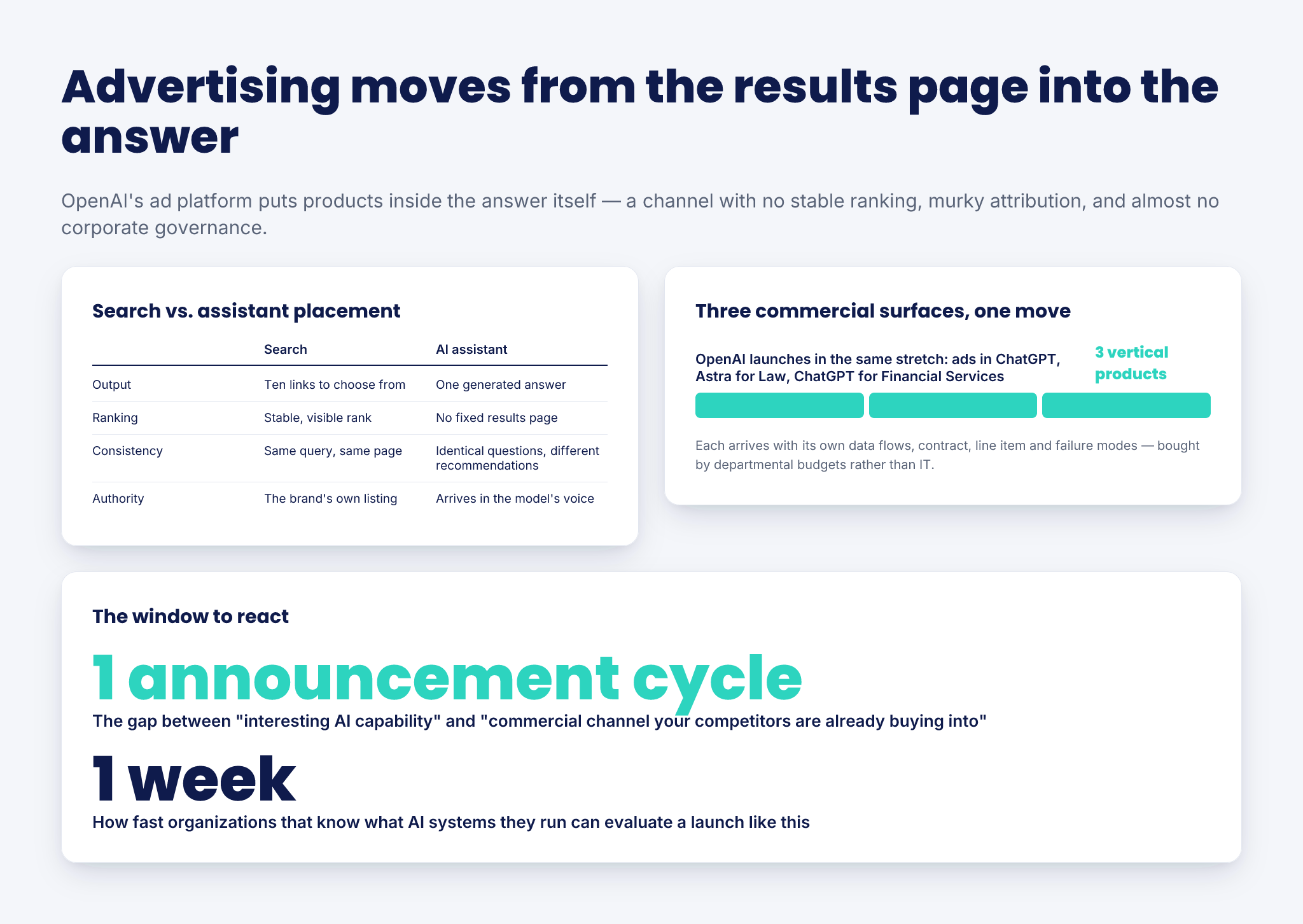
What makes this different from a banner ad is the position it occupies. A search engine returns ten links and lets you choose. An assistant returns an answer. When a product appears inside that answer, it arrives wearing the model's authority — the same voice that just helped you debug your code or draft your resignation letter. That is an enormously valuable placement, and an enormously consequential one.
The channel you can't optimize the old way
For twenty years, digital marketing has been a game of legible mechanics. You bid on keywords. You know your rank. You see impressions, clicks, and cost per acquisition, and you tune accordingly.
AI-mediated discovery breaks most of that. There is no stable ranking, because there's no fixed results page — the response is generated fresh each time, conditioned on a conversation that may be twenty turns deep and reference things the user said last month. Two people asking functionally identical questions can get different recommendations. Attribution gets murkier: did the customer arrive because of a paid placement, or because the model mentioned you organically while answering something adjacent?
This is already happening whether or not you buy ads. Models recommend products constantly, unprompted, based on whatever they absorbed in training and retrieval. A formal ad platform doesn't create that dynamic — it puts a price on the part of it that's purchasable and leaves the rest unmanaged.
The pattern underneath: AI is going vertical and commercial
The advertising launch didn't arrive alone. In the same stretch, OpenAI shipped Astra for Law — its flagship model configured as a foundation for legal work — and ChatGPT for Financial Services, built with Morgan Stanley and Evercore, bundling financial data into the assistant.
Read together, these are the same move in three costumes. The general-purpose chat box is being packaged into specific commercial surfaces: an ad network, a legal workspace, a finance workspace. Each one comes with its own data flows, its own contract, its own line item, and its own failure modes.
For anyone tracking AI inside an organization, this is the structural shift that matters more than any individual launch. AI is no longer one vendor relationship managed by IT. It's fragmenting into departmental products bought by departmental budgets — legal buys the legal one, finance buys the finance one, marketing buys the ad platform. This is precisely how shadow IT became a decade-long headache, replayed at higher speed and higher stakes.
What to actually do about it
Three things worth doing in the next quarter, none of which require a committee.
- Find out what the models say about you. Before spending a dollar on AI placement, establish a baseline. Ask the major assistants the questions your customers ask — "best tool for X," "alternatives to competitor Y," "is vendor Z any good" — and record the answers. Do it monthly. You cannot manage a channel you've never observed, and right now most companies have literally never looked.
- Put AI ad spend in the AI inventory, not just the marketing budget. When marketing starts buying placements through an AI platform and generating creative with AI tools, that's an AI system touching customers and brand — with no security review, no model documentation, and no owner outside the growth team. The fact that it shows up as media spend rather than software spend is an accounting detail, not a governance one.
- Decide your disclosure posture now. If AI-generated creative ends up in your campaigns, someone will eventually ask what was machine-made and what wasn't. Answering that from records is easy. Reconstructing it under pressure, eighteen months later, is not.
The broader lesson is about pace. The gap between "interesting AI capability" and "commercial channel your competitors are already buying into" has collapsed to roughly one announcement cycle. Organizations that know what AI systems they run, what those systems cost, and who owns each one can evaluate a launch like this in a week. Organizations that don't will find out they're in the channel when someone forwards them a screenshot of a competitor's product inside an answer that should have been theirs.