

Anthropic's new Claude Sonnet 5.5 ships with cyber-specific safeguards while leaving routine coding and life-sciences work untouched — a narrower, more surgical approach to AI risk-gating than most enterprises have seen.
Most conversations about AI safety happen at the level of the whole model. Is it safe? Should we deploy it? Does it pass eval X or benchmark Y? That framing treats a model like a single light switch: on or off, trusted or not. Anthropic's release notes for Claude Sonnet 5.5 suggest a different mental model is starting to take hold inside at least one frontier lab — one where safety isn't a property of the model as a whole, but of specific capabilities within it.
What actually shipped
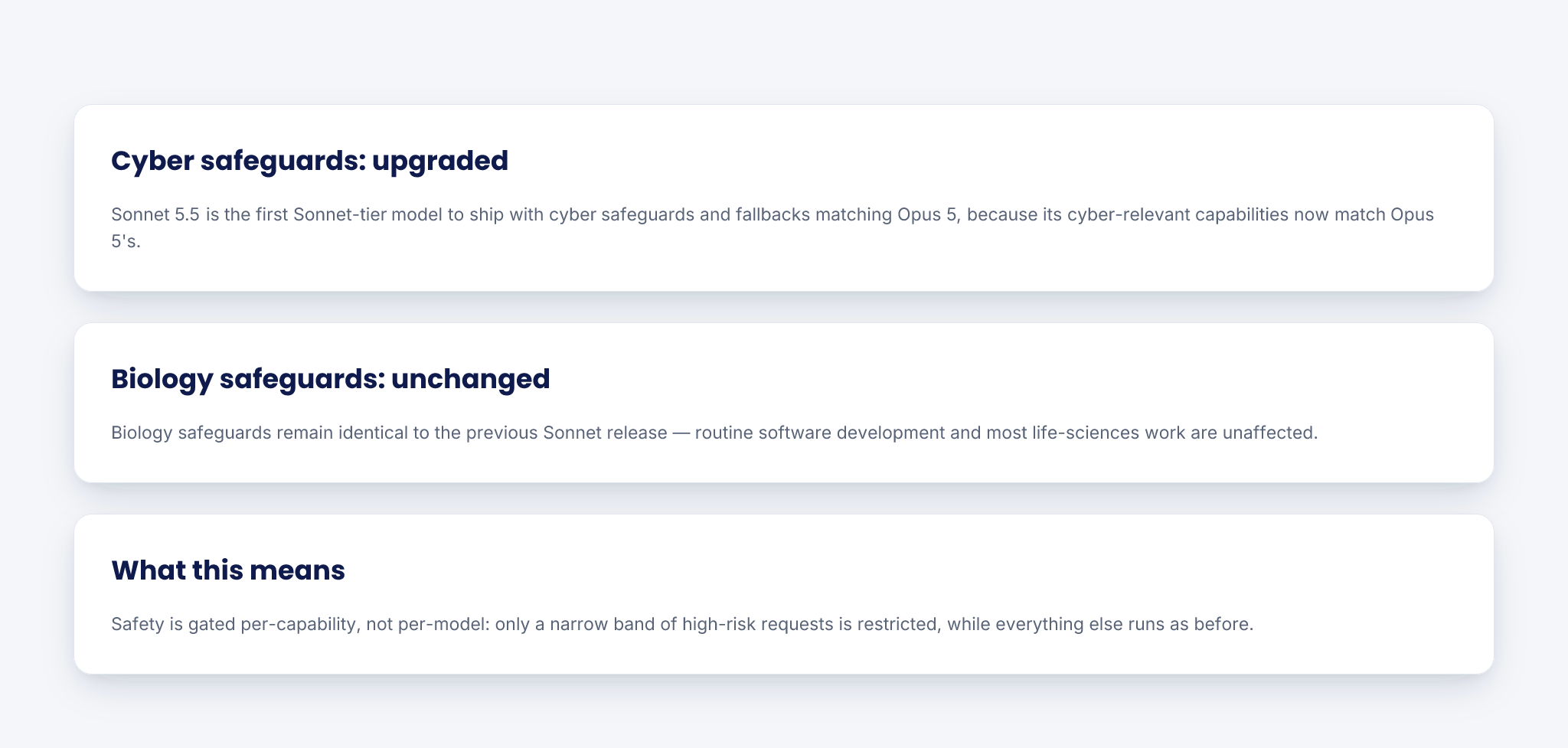
According to Anthropic's own release documentation, Sonnet 5.5 is the first Sonnet-tier model to launch with "cyber safeguards and fallbacks" comparable to those built for Opus 5, its more capable sibling. The reason given is straightforward: Sonnet 5.5's cybersecurity-relevant capabilities are now comparable to Opus 5's, so it inherits the same guardrails in that domain. Its biology safeguards, by contrast, stay identical to the previous Sonnet release — because, per Anthropic, "both safeguards target a narrow set of high-risk requests; routine software development and most life sciences work are unaffected."
That's a meaningfully different shape of restriction than "don't let the model do X." It's closer to: identify the narrow band of requests inside a much larger capability surface that actually carries elevated risk, and gate only that band. Software engineers debugging a dependency conflict, or biologists running a standard protein-folding query, shouldn't notice any difference. Someone attempting to use the model to accelerate a specific class of offensive cyber operation should.
Why this matters beyond the release notes
This connects to a broader and genuinely uncomfortable theme Anthropic has been raising elsewhere: its recent research on GLM-5.3 described how advanced cyber capabilities are starting to spread across the industry, not stay contained to one or two labs at the frontier. If capability is diffusing faster than any single company's policy can contain, then "don't release models with capability X" stops being a viable strategy — because other models with capability X will exist regardless. What's left is a quieter, less dramatic lever: build fine-grained detection and response specifically around the handful of request types that matter, and leave everything else alone.
Whether this becomes a durable pattern across the industry, or whether it's a one-off engineering choice specific to how Anthropic happened to structure Sonnet 5.5's training and evaluation pipeline, is genuinely unclear from what's public. It's worth being honest about that uncertainty rather than pretending this is the start of a trend with a track record — it isn't, yet. What we can say is that it's a concrete example of a lab treating "is this model safe" as a question with a different answer for different capabilities, rather than one answer for the whole system.
The enterprise angle
If you're procuring or governing AI tools, this should change a question you ask vendors. "Is this model safe to deploy" is the wrong granularity. The more useful question is: which specific capabilities inside this model have been evaluated and gated, and which haven't? A model can be extensively safeguarded against one category of misuse — cyber offense, say — while being essentially ungoverned in another domain nobody thought to test, because nobody flagged it as a narrow high-risk band worth isolating.
This is exactly the gap a systems inventory is built to catch. Most AI governance programs today record which models are approved and who owns them. Far fewer record which specific capabilities within those models carry elevated risk, whether the vendor has published anything about safeguards at that capability level, and whether your own use case even touches the gated band in the first place. A model's cyber safeguards are irrelevant to your marketing team's content pipeline — but if a cybersecurity or SOC team starts piping incident logs through the same model, that detail stops being irrelevant fast.
The practical move isn't to assume every vendor is doing capability-level gating as carefully as this release description suggests Anthropic did. It's to ask. Which specific functions in this model have dedicated safeguards? What's excluded from those safeguards, and why? And does your deployment sit inside or outside the gated band? Those are answerable questions today, for any vendor relationship — and most AI inventories currently have no field to record the answer.