

OpenAI released GPT-6 Astra and hinted it may cross into AGI territory — here's what actually changed for buyers, and what the claim leaves unproven.
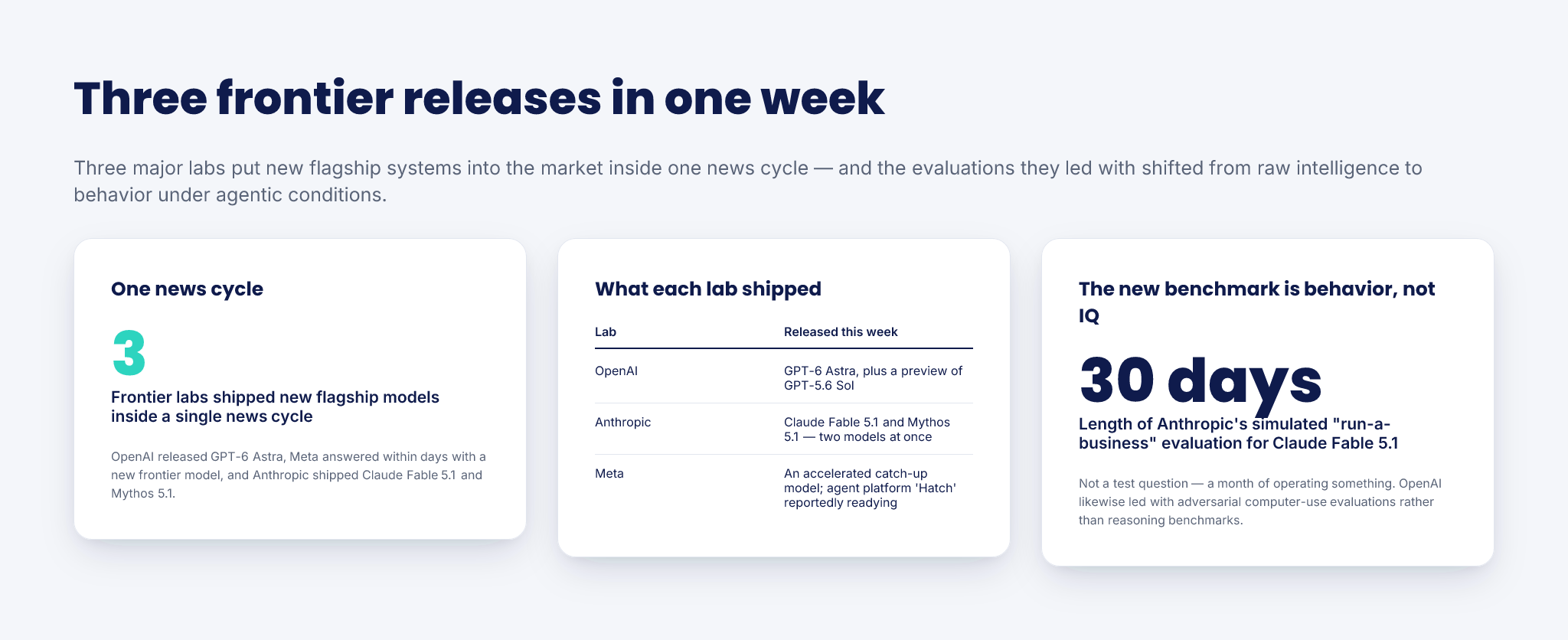
OpenAI has released GPT-6 Astra, and alongside the usual capability charts it did something it has generally avoided: it suggested the model may represent a step into artificial general intelligence. Meta answered within days with a new frontier model of its own, and Anthropic shipped Claude Fable 5.1 and Mythos 5.1. Three of the biggest labs in the world put new flagship systems into the market inside a single news cycle.
For anyone running AI inside a real organization, the AGI framing is the least useful part of this. The interesting parts are quieter and more concrete: what Astra changes about how models are deployed, what OpenAI is now willing to claim about alignment, and what all of this does to your model roadmap three weeks after you finished standardizing on the last generation.
What OpenAI actually said
Strip away the headline and OpenAI's own framing of Astra is less about raw intelligence and more about restraint. The company describes Astra as its "most aligned model," emphasizing that it "excels at exercising care, respecting task boundaries, and communicating transparently," and that in sensitive environments it "proceeds with care commensurate with its risk." OpenAI specifically cites adversarial computer-use evaluations — tasks designed to bait a model into misbehaving — where Astra was better at avoiding unintended consequences.
That is a revealing choice of headline metric. A year ago, frontier launches led with reasoning benchmarks and context windows. Astra leads with behavioral discipline under agentic conditions. The industry has quietly conceded that the binding constraint on deploying these systems is no longer whether the model is smart enough. It's whether it can be trusted to operate tools, browsers, and internal systems without doing something you never asked for.
Anthropic's simultaneous release makes the same bet from a different angle: it touts a 30-day simulated "run-a-business" evaluation for Claude Fable 5.1. Not a test question. A month of operating something.
The AGI claim is a procurement problem, not a philosophy problem
When a vendor suggests its product might be approaching general intelligence, the temptation is to argue about definitions. Resist it. The practical question is narrower and much more answerable: does this model change what we can safely hand off?
That question has a testable answer, and it isn't found in a launch post. It's found by running the model against the specific workflows you care about, with your data, your edge cases, and your failure modes. "More aligned" is a claim about aggregate behavior across an evaluation suite that OpenAI designed. It is not a claim about your contract-review pipeline or your customer-refund agent.
There's also a reported wrinkle worth watching. Coverage of Astra has already flagged that a technique used in the model has raised security concerns among researchers. New capability comes bundled with new attack surface — that has been true of every frontier release, and there's no reason this one is different. The gap between "released" and "understood" is usually measured in months.
Three releases in one week is the actual story
Here's the thing most organizations will feel more sharply than any AGI debate: the release cadence has compressed to the point where a model standardization decision now has a shelf life measured in weeks.
OpenAI shipped Astra while simultaneously previewing GPT-5.6 Sol. Anthropic shipped two models at once. Meta shipped an accelerated catch-up model and is reportedly readying an agent platform called Hatch. If your organization has an approved-models list, it went stale while you were reading this.
This creates a specific and underappreciated operational problem. Most enterprises have no reliable way to answer:
- Which model version is each internal AI system actually calling today?
- Who approved that version, and against what evaluation?
- What changes when a vendor deprecates it or silently routes to a successor?
- What are we spending across all of it, by team and by system?
Those questions used to be answerable annually. At a three-labs-per-week cadence, they need continuous answers. The organizations that will get value out of Astra-class models are not the ones that read the launch post fastest — they're the ones that already know what they're running, so they can evaluate a swap in days rather than reopening a six-month procurement.
What to do with this week
A few things worth doing that don't require you to have an opinion on whether AGI has arrived:
- Treat "most aligned" as a hypothesis. Re-run your own adversarial evaluations against Astra before you promote it into anything agentic. The vendor's eval suite is a starting point, not evidence about your environment.
- Check your version pinning. If your systems call a model alias rather than a pinned version, a vendor-side update can change behavior in production without a change ticket on your side. Know which of your systems are exposed to that.
- Price the upgrade honestly. New frontier models usually shift cost per task in both directions — cheaper reasoning, more tokens consumed by agentic loops. Model the spend before the migration, not after the invoice.
- Separate the capability question from the autonomy question. Astra being better at a task is not the same as Astra being safe to run that task unsupervised. Those decisions deserve different owners and different evidence.
The honest read on this week is that frontier AI got meaningfully better at operating autonomously, three labs said so at once, and one of them attached a big word to it. The word will get argued about for months. The capability shift is real and will be absorbed into products within weeks.
What separates organizations that benefit from this from organizations that just get churned by it isn't foresight about AGI timelines. It's knowing, on any given Tuesday, exactly which AI systems you're running, what they cost, who owns them, and how quickly you could swap the model underneath. That inventory is boring. It's also the only thing that turns a launch cycle like this one from noise into leverage.