

The EU's new "AI Omnibus" (Regulation 2026/1744) revises AI Act deadlines and relaxes some obligations — so any rollout plan built on the old dates is now out of date.
For two years, compliance teams treated the EU AI Act like a fixed monument: known obligations, known dates, plan backward from them. On August 2026 that assumption broke. The European Union enacted the AI Omnibus (Regulation (EU) 2026/1744), a package that streamlines compliance rules and rewrites several transition timelines inside the AI Act.
The core risk obligations are still active. High-risk classification, prohibited practices, and transparency duties have not disappeared. But the sequencing and the immediacy of certain requirements have changed — and that is exactly the kind of change that quietly invalidates a governance program built on last year's project plan.
What actually changed
The Omnibus is a streamlining instrument, not a repeal. Three shifts matter most for enterprises:
- Revised transition timelines. Some conformity and documentation deadlines have moved, giving organizations more runway to align. That is relief — but only if you know which of your systems the extension applies to.
- Relaxed near-term competence requirements. Certain immediate AI-literacy and staffing obligations have been softened or deferred, reducing the pressure to staff up on an artificial clock.
- Simplified compliance mechanics. The package trims procedural overhead in places where the original text created duplicative or ambiguous obligations.
None of this makes the AI Act easier to ignore. It makes the Act a moving target — and a moving target is harder to govern than a hard one, because your plan can silently drift out of alignment without anyone noticing.
Why "relief" is a trap without a control plane
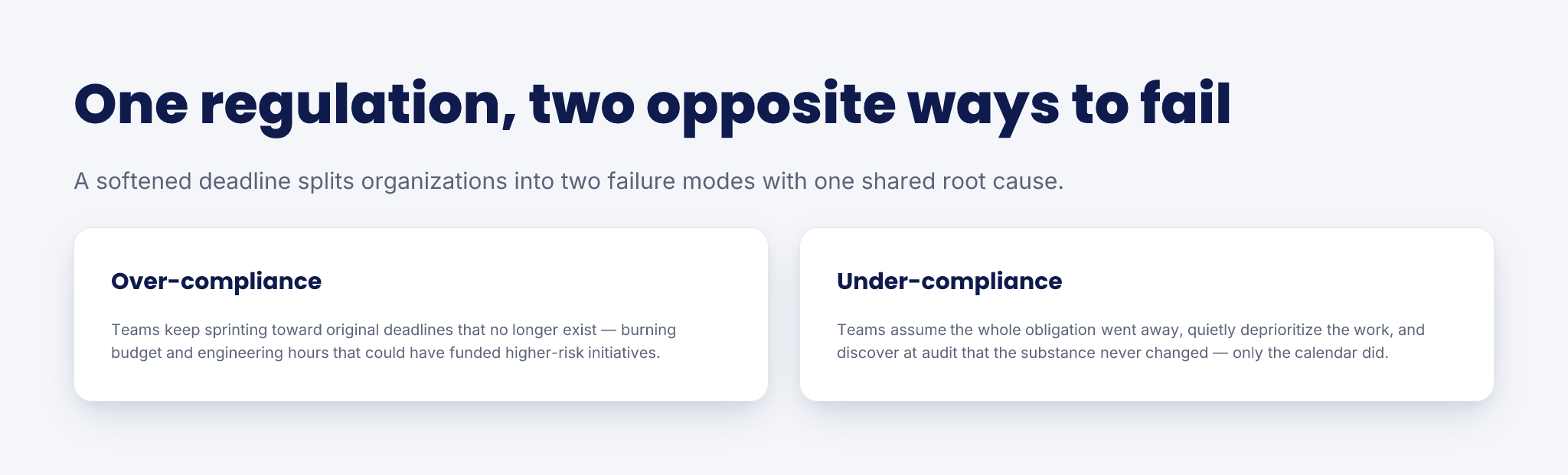
A softened deadline sounds like good news. In practice it creates two opposite failure modes, and most organizations will fall into one of them.
- Over-compliance. Teams that built aggressive internal deadlines against the original timeline keep sprinting — burning budget and engineering hours to hit dates that no longer exist. That capital could have funded higher-risk initiatives.
- Under-compliance. Teams that hear "the EU relaxed the rules" assume the whole obligation went away, quietly deprioritize the work, and discover at audit time that the substance never changed — only the calendar did.
Both failures share one root cause: the organization treated the regulation as a single event instead of a set of per-system obligations mapped to shifting dates. When the dates move, a spreadsheet doesn't tell you what's now over-scoped or under-scoped. It just sits there, confidently wrong.
What compliance leaders should do now
The Omnibus is a re-baselining event. Treat it like one.
- Re-map every obligation to the new dates. Go obligation by obligation, not headline by headline. Which of your AI systems are high-risk? Which transparency duties apply? What is the revised deadline for each, and which extensions actually cover your use cases?
- Re-prioritize the initiatives you already have in flight. Anything you were sprinting toward on an old date should be reassessed. Freed-up capacity should move to genuinely higher-risk gaps — not stay locked to an obsolete milestone.
- Separate "deferred" from "removed." Build an explicit list of obligations whose timing changed versus obligations whose substance changed. Confusing the two is how under-compliance happens.
- Version your governance evidence. When regulators or auditors ask why you sequenced work the way you did, you need to show you were tracking against Regulation 2026/1744 — not the superseded timeline. Dated, defensible decisions matter.
- Set a re-check trigger. The Omnibus proves the AI Act is legislation-in-motion. Assume more amendments are coming and assign an owner to monitor and re-map on each change.
The deeper lesson: regulation is now a live feed
The AI Omnibus is the second signal this year — alongside the DOJ's challenge to Colorado's AI Act — that AI regulation is not a stable target you comply with once. It is a live feed of changing obligations, deadlines, and enforcement postures across jurisdictions. The EU can relax a timeline in Brussels the same month a U.S. federal agency sues to preempt a state law.
An organization that manages this in documents will always be one amendment behind. The organizations that stay aligned are the ones treating governance as an operational system: a live inventory of AI systems, each mapped to the specific obligations and dates that apply, so that when a regulator moves the goalposts, the whole program re-prioritizes instead of quietly drifting.
That is the entire premise of a governance control plane. Inventory your AI systems, track the spend behind them, measure your maturity across the dimensions regulators actually examine, and turn the resulting gaps into prioritized initiatives — initiatives you can re-sequence the moment the rules change. The Omnibus didn't make the AI Act go away. It made the ability to re-baseline on demand a core governance capability.
The takeaway: The EU didn't loosen the AI Act — it made it move. If your compliance plan is a static artifact, it's already out of date. Re-map, re-prioritize, and build the muscle to do it again next time the goalposts shift.