

The EU AI Act's Article 4 literacy mandate is now enforceable — you must show documented AI training for staff and the vendors who run AI on your behalf.
Most AI Act coverage has fixed on the dramatic obligations: model documentation, high-risk conformity assessments, transparency labels for synthetic media. But a quieter requirement just entered its enforcement stage — and it applies to nearly every organization touching AI, not only high-risk deployers.
Article 4 requires that providers and deployers of AI systems ensure a sufficient level of AI literacy among their staff and anyone operating AI systems on their behalf. As of August 2026, this is no longer aspirational language. Regulators are treating it as a live obligation.
What Article 4 actually requires
The text is short, which is precisely why it is easy to underestimate. It obliges organizations to take measures ensuring, "to their best extent," that people involved in operating and using AI systems have the knowledge to do so responsibly — accounting for their technical background, the context of use, and the people affected by the system.
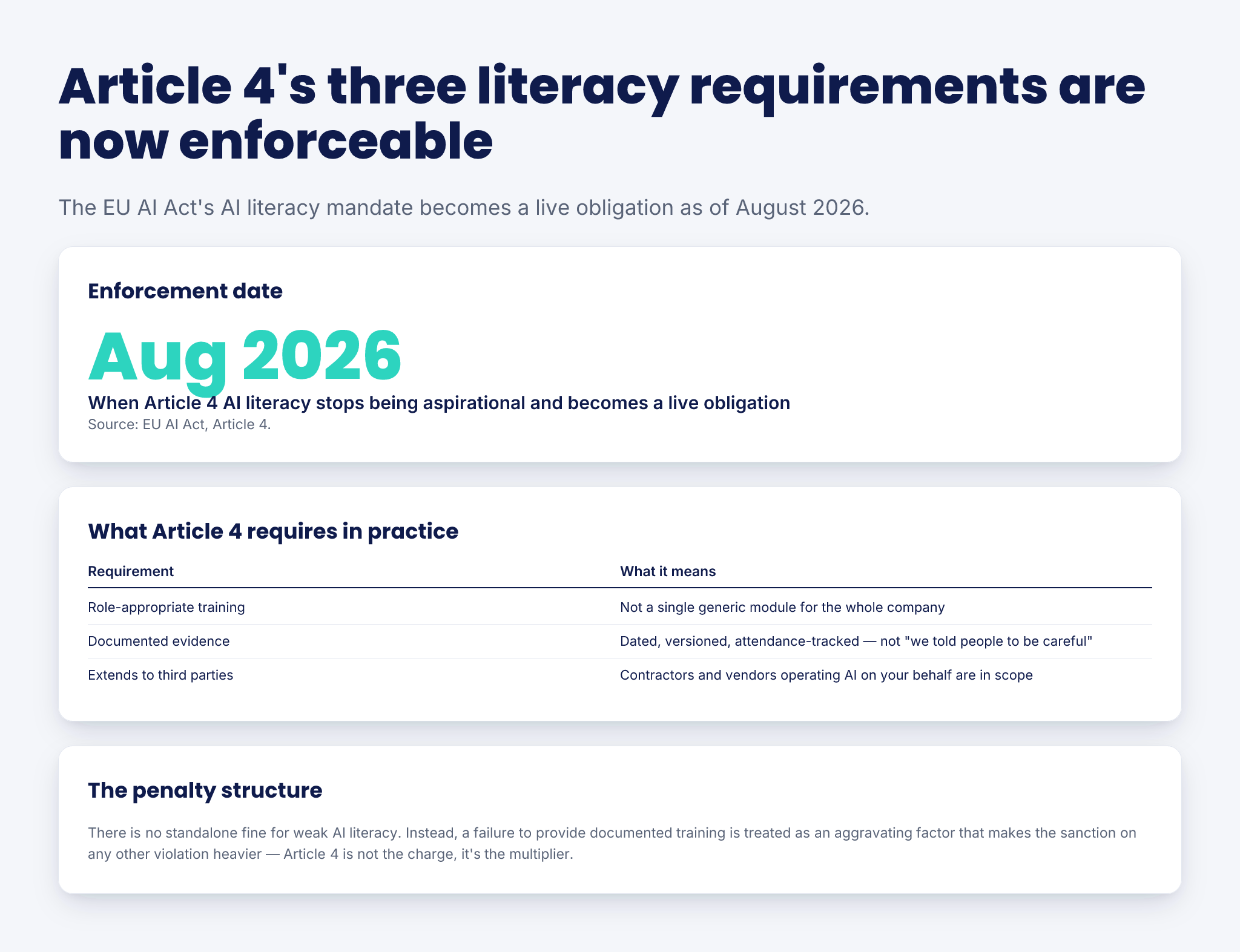
In practice that means three things:
- Everyone who touches an AI system needs role-appropriate training — not a single generic e-learning module for the whole company.
- The training has to be documented. "We told people to be careful" is not evidence. A dated, versioned, attendance-tracked program is.
- The obligation extends to third parties. Contractors and vendors operating AI systems on your behalf fall inside your literacy perimeter.
That third point is the one catching compliance teams off guard.
The "no direct fine" trap
Here is the detail that gets Article 4 dismissed too quickly: there is no standalone penalty attached to it. You cannot be fined a fixed percentage of turnover purely for weak AI literacy.
That framing is dangerously reassuring. Regulators have signaled that a failure to provide documented training will be treated as an aggravating factor when assessing other violations. In other words, Article 4 is not the charge — it is the multiplier.
Imagine an incident: an employee feeds regulated personal data into a generative tool, or a deployed system produces a discriminatory output. When the regulator investigates the underlying breach, the first question becomes whether the people involved were competent to operate the system safely. If your answer is a shrug, the sanction on the primary violation gets heavier. Article 4 shapes the downside of every other failure.
Why your vendor perimeter is the exposure
The phrase "on their behalf" quietly widens the obligation well past your payroll. If a managed-services partner operates a model for you, if a staffing agency's contractors use AI tooling inside your workflows, or if a SaaS vendor runs AI features on your data, those operators are inside your literacy scope.
Almost no one has mapped this. Most organizations cannot produce a list of every AI system running in their environment, let alone confirm that the external people operating those systems have received documented, role-appropriate training. You cannot train the operators of systems you have never inventoried.
This is where AI literacy stops being an HR checkbox and becomes a governance data problem.
Turning a training mandate into a governance control
Treat Article 4 the way you would any other auditable control: as something that produces evidence on demand. That requires connecting three things most enterprises keep in separate silos.
- A live inventory of AI systems. You need to know what AI is in use, who deploys it, and which internal teams and external vendors operate it. Without this, "sufficient literacy across all operators" is unmeasurable.
- Role-mapped competency requirements. A data scientist tuning a model, a claims adjuster relying on its output, and a procurement lead onboarding an AI vendor need different training. Map training tiers to the roles that actually interact with each system.
- Evidence you can hand an auditor. Completion records, dates, content versions, and vendor attestations — stored against the specific systems they cover, so you can prove literacy for any given deployment rather than gesturing at a company-wide average.
This is the difference between a training program and a governance control. A program tells people what to do. A control proves, at any moment, that they were equipped to do it — and closes the aggravating-factor gap before a regulator ever opens it.
What to do this quarter
- Inventory first. Enumerate every AI system in use and, critically, tag which vendors and contractors operate them on your behalf.
- Tier your training by role and by system risk, rather than defaulting to one universal module.
- Extend contractual obligations to vendors so that third-party operators must maintain and evidence their own AI literacy.
- Assess the gap as a maturity dimension. Workforce competency is one of the pillars of a mature governance posture — measure where you stand, then convert the shortfall into a prioritized initiative with an owner and a date.
Article 4 is a reminder that AI governance is not only about models and documentation. It is about people — and whether you can prove they knew what they were doing. The organizations that treat literacy as an inventoried, evidence-producing control will find that the "aggravating factor" quietly becomes a mitigating one instead.