

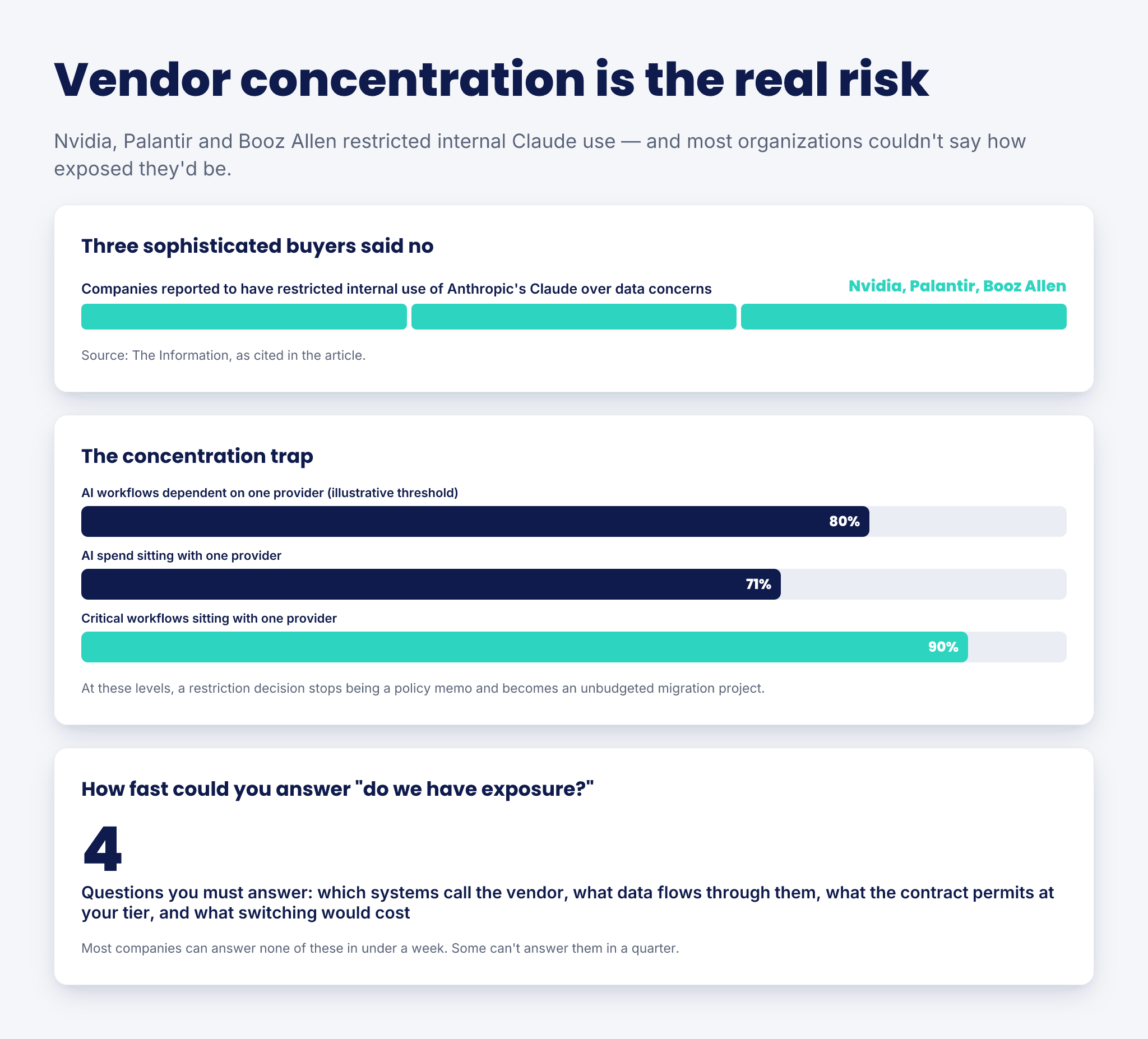
Nvidia, Palantir, and Booz Allen have restricted internal use of Anthropic's Claude over data concerns — a signal that AI vendor choice is now a strategic decision.
According to reporting from The Information, three of the most technically sophisticated companies in the market — Nvidia, Palantir, and Booz Allen Hamilton — have restricted internal use of Anthropic's models, citing concerns about data.
That's a strange sentence to write. These are not risk-averse laggards waiting for the technology to mature. Nvidia sells the compute the whole industry runs on. Palantir's entire business is deploying software into the most sensitive environments on earth. Booz Allen advises the U.S. government on exactly this kind of decision. If anyone has the in-house expertise to evaluate a frontier model vendor, it's these three.
And they decided the answer was: not this one, not internally, not right now.
This isn't a security review. It's a strategy call.
The instinct is to file this under "data privacy concerns" and move on. That undersells what's happening.
When a company like Nvidia restricts a model vendor, several things are in play at once, and only some of them are about encryption and retention policies:
- Competitive proximity. Anthropic is increasingly building products that overlap with what its own enterprise customers sell. When your AI vendor is also drifting into your market, every prompt your employees write becomes a strategic question, not just a compliance one.
- What the terms actually permit. Contract language about training, retention, and usage analysis varies enormously between vendors and between tiers of the same vendor. Most enterprises have never read theirs closely enough to brief a board on it.
- Concentration. If 80% of your AI workflows depend on one provider, a restriction decision isn't a policy memo — it's a migration project with a cost nobody budgeted.
That third one is the part most organizations are unprepared for, and it's the reason this story matters even if you have no opinion about Anthropic.
The consolidation trap
For two years the standard enterprise AI advice was: pick a provider, go deep, stop fragmenting your spend. It was good advice. Fragmentation across five vendors means five security reviews, five billing relationships, five sets of prompts that don't transfer, and no leverage at renewal.
So companies consolidated. They standardized on one frontier model, built internal tooling around its API, trained staff on its quirks, wired it into their retrieval systems and agent frameworks, and negotiated an enterprise agreement.
Then the ground moved. A vendor changed its terms. Or launched a product that competes with yours. Or had an incident. Or got restricted by a government customer you also serve. And suddenly the question is: how fast could we actually switch?
For most organizations, the honest answer is "we don't know," followed closely by "we're not sure which systems would even be affected."
The question you can't answer without an inventory
Here's a useful exercise. Imagine your CEO forwards you this news tomorrow morning with a one-line email: "Do we have exposure here?"
To answer, you'd need to know:
- Every system that calls that vendor's models — not just the sanctioned platform, but the dev tools, the embedded features in SaaS products you buy, the agent frameworks, the browser extensions, the scripts someone wrote in a hackathon that now runs in production.
- What data flows through each one — customer records, source code, pricing models, unreleased roadmaps, legal documents.
- What your contract actually says about each of those flows, at the tier you're actually on.
- What it would cost to move — prompt rewrites, evaluation re-runs, latency and quality regressions, retraining staff, renegotiating pricing.
Most companies can answer none of these in under a week. Some can't answer them in a quarter. That gap is the real story here — not which vendor got restricted, but how few organizations could respond to a restriction decision with anything other than a panicked Slack thread.
What good looks like
The organizations that handle this well aren't the ones that predicted which vendor would become a problem. They're the ones that built for the possibility that any vendor might.
Keep a live inventory, not an annual survey. AI systems get added weekly. A spreadsheet updated each January tells you what was true eleven months ago. Track spend per vendor, per system. Concentration risk is invisible until you can see that 71% of your AI spend and 90% of your critical workflows sit with one provider. Build an abstraction layer, but don't oversell it. Routing through a common interface helps. It doesn't eliminate the prompt tuning, evaluation work, and behavioral differences that make real switching slow. Know the difference between "portable in principle" and "portable by Friday." Read the terms at the tier you're on. Enterprise agreements, zero-retention configurations, and consumer tiers have meaningfully different data postures. Employees often use whichever one is easiest to log into. Rehearse the switch. Pick one meaningful workload and actually run it on a second model. You'll learn more in a week than in any vendor questionnaire.None of this means Anthropic's models are unsafe, or that these three companies made the right call. We don't have the full picture, and reasonable organizations will land in different places.
What it does mean is that the question "which AI vendor do we use?" has quietly become a question about competitive positioning, data strategy, and operational resilience — decided by people who may never have thought of themselves as making a strategic bet.
If a major vendor became untenable for your organization tomorrow, how long would it take you to find out what breaks? That number is a better measure of AI maturity than anything on your adoption dashboard.