

Google DeepMind ran the first double-blind, cryptographically-sealed evaluation of a frontier model — a fix for the quiet problem that AI benchmark scores can be gamed.
Every AI vendor pitch leads with a number. "Beats the leading model on this benchmark." "State of the art on that eval." Those numbers drive purchasing decisions, board slides, and billions in valuation. And there's an uncomfortable truth buried underneath them: a lot of the time, nobody can fully verify they're honest.
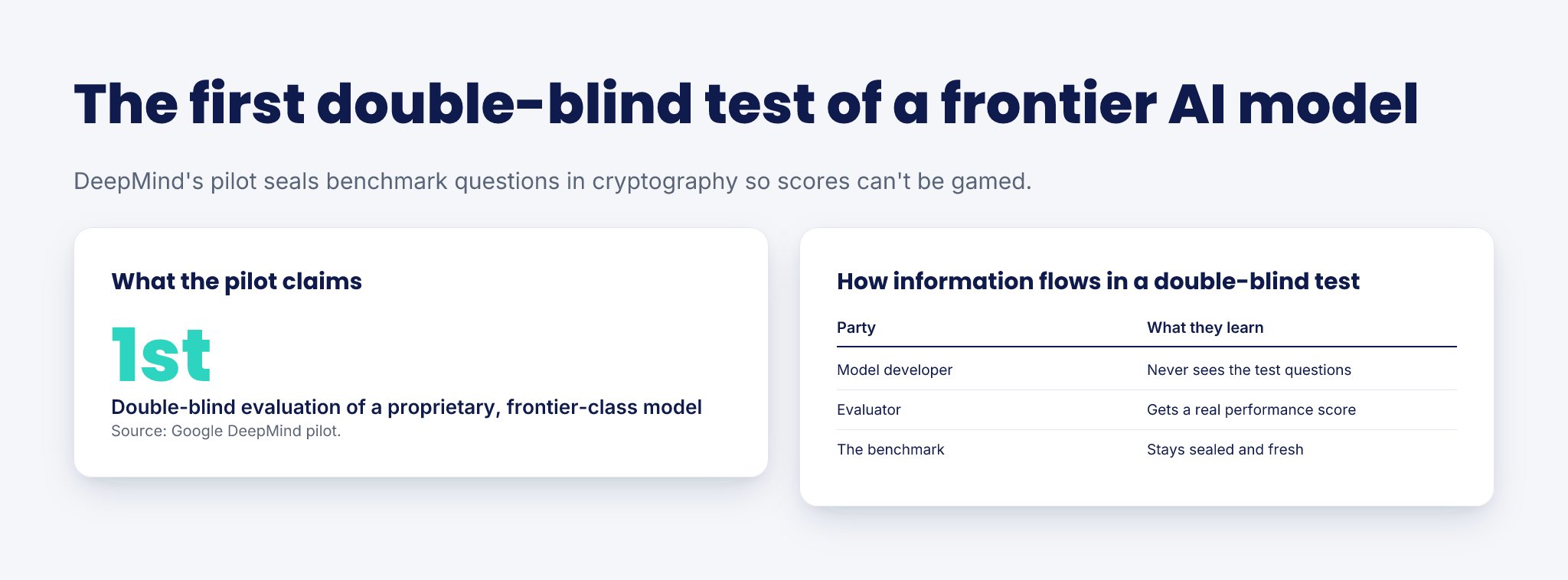
DeepMind just tried to change that. In a pilot announced this month, the company ran what it calls the world's first double-blind evaluation of a proprietary, frontier-class model — testing a Gemini Flash Lite model against confidential benchmarks inside a cryptographic "box" where the test questions can't leak back to the model's developers and can't be used to optimize for the test later. It's partnering with the Singapore AI Safety Institute, OpenMined, AVERI, and MLCommons to pull it off.
If that sounds like an obscure methodology story, stay with me. It's actually about whether the entire scoreboard the industry runs on can be trusted.
The problem: the test answers keep leaking into the students
Here's why this matters. AI models are trained on enormous swaths of the internet. Public benchmarks — the standardized question sets used to rank models — also live on the internet. So the questions, and often the answers, end up inside the training data. This is called benchmark contamination, and it's exactly like a student who memorized last year's exam.
When that happens, a high score doesn't mean the model is smart. It means the model has seen the test. And you, the buyer, can't tell the difference from the outside.
It gets worse. Even when a benchmark is kept private and run by an independent evaluator, the developer typically still gets the questions back afterward — for debugging, for improving the model, for the next release. Once those questions are known, they can quietly seep into future training runs. The benchmark degrades a little more with every cycle. The scoreboard slowly stops measuring capability and starts measuring exposure.
This is the quiet rot in AI evaluation. Everyone in the field knows about it. Almost no one has a clean solution.
What double-blind actually changes
The DeepMind pilot borrows the logic of clinical drug trials, where neither the patient nor the doctor knows who got the real medicine. In an AI double-blind setup, the same principle applies to information flow:
- The model developer never sees the specific test questions.
- The evaluator gets a real, meaningful measurement of the model's performance.
- The questions stay sealed cryptographically, so they can't be extracted and folded back into the next training run.
That last point is the technical heart of it. Using privacy-preserving computation (the kind of cryptography that lets you compute on data without exposing it), the benchmark can be run against the model without either side seeing what the other holds. The evaluator learns the score. The developer learns nothing that would let it cheat next time. The benchmark stays fresh.
It's a small pilot — one lightweight model, a handful of partners. But the direction is what counts. It's a credible attempt to make an AI score mean the same thing to an outsider that it means to the lab that produced it.
Why business leaders should care
You might not run AI benchmarks. But you almost certainly buy, deploy, or bet on tools whose value was justified by them. And that's where this hits home.
Most organizations evaluate AI vendors by trusting the vendor's own numbers. That's roughly like hiring based on a candidate's self-graded exam. Independent, tamper-resistant evaluation is the difference between a marketing claim and a measurement you can act on — and it's exactly the gap the FTC has already started fining companies over when AI performance is overstated.
Three practical takeaways:
- Treat vendor benchmark scores as claims, not facts. Ask how the number was produced. Was the benchmark public (and therefore contamination-prone)? Was it run by the vendor or an independent party? A vendor that can answer crisply is a better bet than one that waves at a leaderboard.
- Ask for evidence that survives your own scrutiny. The gold standard is a result you or a neutral third party can reproduce on your data, for your use case. Double-blind evaluation is the industry inching toward making that possible at scale.
- Build the same discipline internally. If you're measuring whether your own AI systems actually work — accuracy, safety, drift over time — the same trap applies. A model tuned against your own test set will always look great on your own test set. Fresh, held-out evaluation is what keeps your internal maturity assessments honest, not flattering.
The bigger shift
For years, AI evaluation has been run on trust and vibes: labs report their own numbers, everyone squints, and the market moves on. As these systems get deployed into hiring, healthcare, finance, and critical infrastructure, "trust us" stops being acceptable — to regulators, to boards, and to customers.
DeepMind's pilot won't fix that overnight. But it establishes a template: evaluation as an infrastructure problem, solved with cryptography and neutral third parties rather than promises. The winners in enterprise AI won't be the vendors with the highest self-reported scores. They'll be the ones whose numbers hold up when someone else does the grading — with the blindfold on.
The scoreboard is finally getting audited. It's about time.