

The U.S. Department of Justice has sued to block Colorado's AI Act on preemption grounds — turning the U.S. state-law patchwork into a moving, litigated target enterprises must still comply with.
For two years, compliance leaders have treated Colorado as the bellwether for U.S. state AI regulation. Now the federal government is trying to strike it down. In August 2026, the DOJ filed suit to block Colorado's Artificial Intelligence Act, arguing its anti-discrimination provisions are preempted by federal frameworks. The law remains active during litigation — which means the least comfortable position of all: a rule you must follow that may not survive the year.
This is not an isolated skirmish. It is the opening move in a fight over who gets to govern AI in the United States, and the answer will reshape every multistate compliance program.
The patchwork just started fighting itself
Until recently, the story was simple: no comprehensive federal AI law, so states filled the vacuum. Colorado led. California followed with chatbot-safety bills and its Transparency Act. Other states drafted their own. Enterprises grumbled about fragmentation but planned around it.
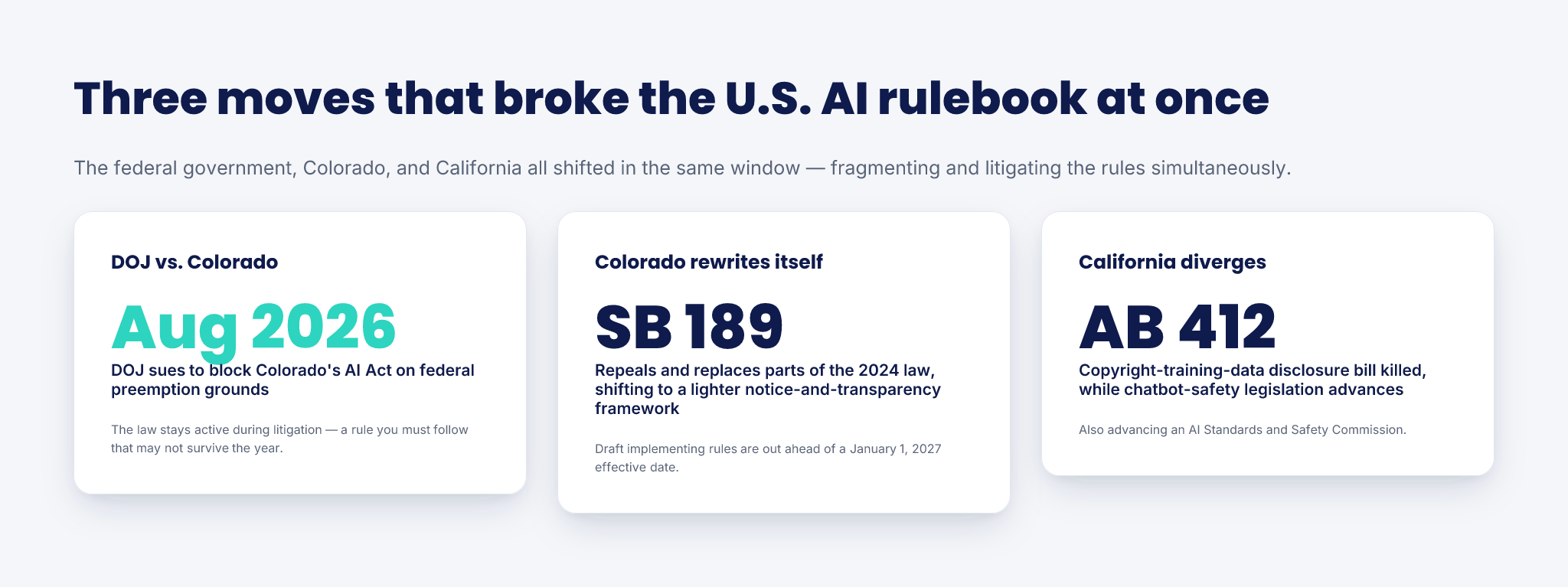
Three things happened almost at once that broke that model:
- The DOJ sued Colorado, asserting federal preemption over state algorithmic-discrimination rules — a direct challenge to states' authority to regulate AI harms.
- Colorado passed SB 189, which repeals and replaces parts of its own pioneering 2024 law, shifting toward a lighter notice-and-transparency framework even as its Attorney General publishes draft implementing rules ahead of a January 1, 2027 effective date.
- California diverged, killing its copyright-training-data disclosure bill (AB 412) while advancing chatbot-safety legislation and an AI Standards and Safety Commission.
Read together, the signal is unmistakable: the U.S. rulebook is not converging. It is fragmenting and being contested in court at the same time. Colorado is simultaneously rewriting its own law, issuing rules under it, and defending it against the federal government.
Why "wait and see" is the wrong posture
The tempting response is to pause: why build for a law that might be struck down or rewritten again? That instinct is a trap for three reasons.
- First, the obligations are live now. Litigation does not suspend a statute. Colorado's law is in force, its draft rules are out for comment, and its 2027 deadlines are real. A preemption ruling could take years and could lose. Betting your compliance posture on a favorable court outcome is not a strategy — it is exposure.
- Second, the underlying risks don't care about jurisdiction. Whether a court blesses Colorado's rules or not, an automated hiring tool that discriminates still produces litigation, and a chatbot that harms a vulnerable user still produces liability. The state laws are codifying risks that already exist. Strike down the statute and the harm — and the lawsuits — remain.
- Third, the requirements rhyme. Notice and disclosure, risk assessments, human oversight, documentation of consequential decisions — these appear in Colorado's rules, California's bills, the EU AI Act, and the FSB's financial-sector guidance alike. The specific citations differ. The controls converge. Build to the controls and you are resilient to which citation survives.
Build for the control, not the citation
The organizations that will weather this fragmentation are the ones that stop treating each law as a separate project and start treating governance as a single control plane. Practically, that means:
- Inventory every AI system and where it operates. You cannot assess exposure to Colorado, California, or EU rules if you don't know which systems touch consumers, employees, or decisions in each jurisdiction. A jurisdiction-tagged inventory is the prerequisite for every other step.
- Map systems to consequential-decision categories. The recurring trigger across statutes is AI that materially affects hiring, lending, housing, insurance, or similar outcomes. Flag those systems now — they carry the highest obligation regardless of which law prevails.
- Standardize on the strictest applicable requirement. Where laws overlap, meeting the toughest version (documented risk assessments, human oversight, consumer disclosure) satisfies the rest. This turns fragmentation from a multiplier into a single baseline.
- Keep evidence, not intentions. A preemption fight, a rule change, or an audit all ask the same question: can you prove what you did? Assessments, disclosures, and oversight logs that produce durable records are the assets that survive both regulators and litigation.
- Track the timeline, not just the rule. SB 189 changed Colorado's obligations mid-stream; the EU's AI Omnibus revised its deadlines; California killed one bill and advanced others. Map your governance milestones to a live regulatory calendar, because the deadlines are moving.
The real lesson of the preemption fight
The DOJ suit will be framed as a story about federalism. For compliance leaders, the practical takeaway is narrower and more urgent: the U.S. AI regulatory landscape is now unstable in both directions. Rules are appearing, being rewritten, and being challenged simultaneously — and you are still accountable throughout.
A governance program pinned to specific statutes will spend the next three years reacting to headlines. A program built on a living inventory, maturity measurement across your risk dimensions, and evidence-producing controls will absorb each change as a configuration update, not a fire drill.
The question is no longer "which law do we comply with?" It's "can our governance survive the law changing underneath us?" Right now, for most enterprises, the honest answer is no.
Evum AI gives you the control plane for this uncertainty: inventory your AI systems, tag them by jurisdiction and risk, measure maturity across five dimensions, and turn the gaps into prioritized initiatives — so a rule change becomes an update, not an emergency.