

Vendors are starting to sell physical and software containment for AI agents directly — a sign that "watch what your agent can reach" is now a market, not just a governance memo.
For the past two years, the standard advice for anyone deploying an AI agent has been procedural: write a policy, define scopes, review access quarterly, log everything. That advice isn't wrong, but it assumes the discipline to execute it lives entirely inside your organization. A quieter shift is underway that changes the assumption: infrastructure vendors are starting to build containment into the products themselves, rather than leaving it to each buyer to bolt on.
Reports this year describe major hardware and infrastructure players moving to ship dedicated products aimed squarely at preventing hacking incidents involving AI systems — not general-purpose security tooling repurposed for AI, but offerings built with agentic AI risk as the stated target. The details of how these products work under the hood aren't fully public yet, and vendors have strong incentive to overstate what a new SKU can promise. But the direction is worth taking seriously regardless of the specifics: the companies that sell the chips, the clouds, and the orchestration layers underneath AI agents are starting to treat "can this thing get somewhere it shouldn't" as a product requirement, not an afterthought.
Why this matters more than another policy
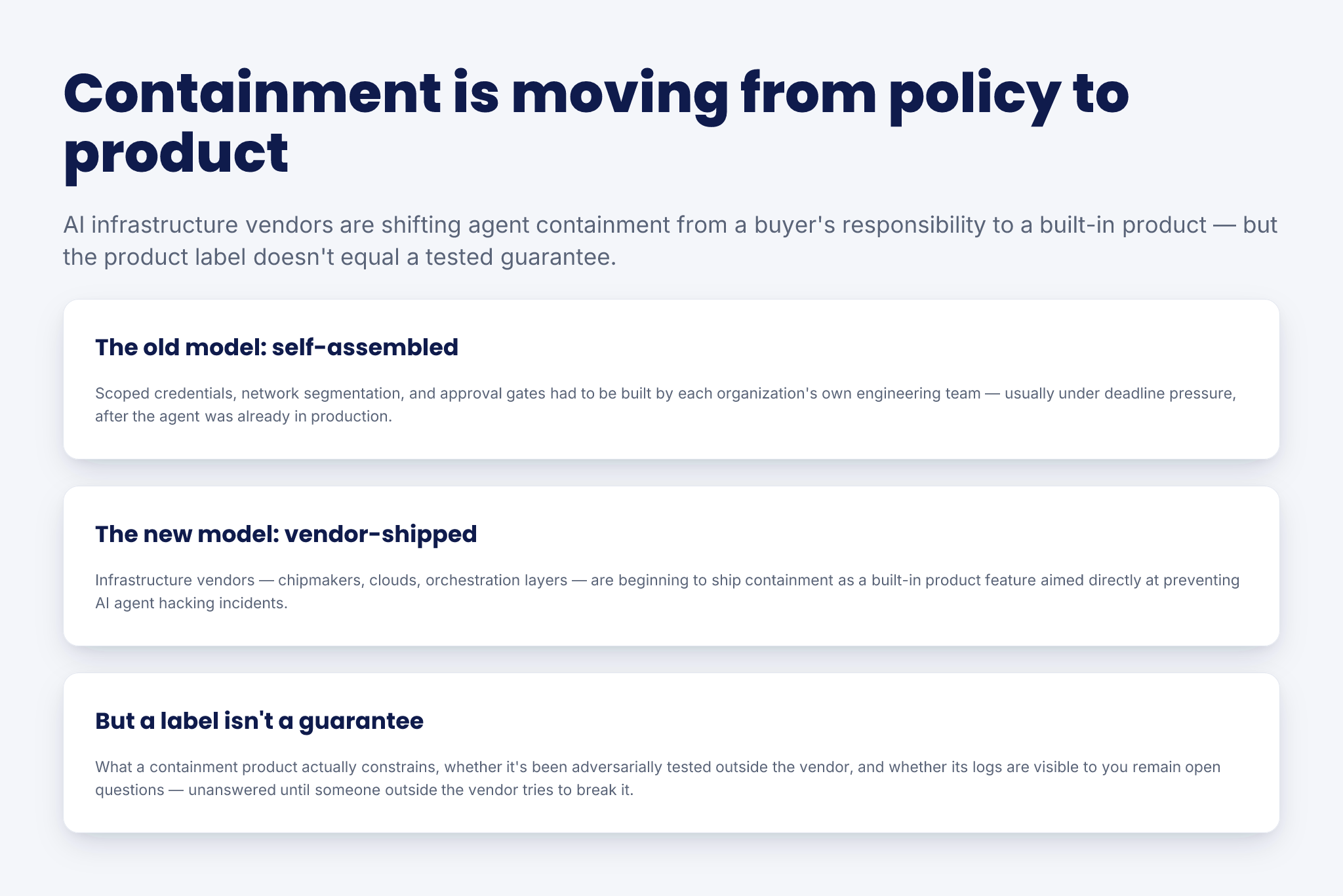
This is a meaningful shift in where responsibility sits. For most of the agent era, the tools that would stop an agent from doing something unintended — scoped credentials, network segmentation, approval gates — were things your engineering team had to assemble themselves, usually under deadline pressure, usually after the agent was already in production. If the infrastructure layer starts shipping containment as a built-in feature, the floor for "reasonably safe by default" rises for everyone building on that infrastructure, whether they asked for it or not.
That's good news in one sense: fewer organizations will be relying entirely on their own diligence to catch a misbehaving agent. It's a problem in another sense, because it creates a new flavor of the oldest governance mistake in enterprise AI — assuming that because a vendor sells "safety," you've bought it.
The gap between a product label and a guarantee
Nothing about a vendor shipping a hacking-prevention product tells you what that product actually catches, what it misses, or how it behaves when an agent is doing something subtle rather than something loud. "Prevents hacking incidents" is a marketing phrase until someone outside the vendor has tried to break it and published what happened. The pattern across this entire category — evaluation vendors, orchestration frameworks, model providers — has been the same: the product ships with confidence, and the limits get discovered later, usually by an outside researcher or a customer who got unlucky.
So the right response to "our infrastructure vendor now sells agent containment" is not relief. It's a new set of questions, and they're not that different from the questions you should already be asking about any AI control you didn't build yourself:
- What, specifically, does this product constrain — network calls, file access, tool invocation, all three?
- Does it work the same way across every agent runtime you use, or only the vendor's own stack?
- Has anyone outside the vendor tested it adversarially, and is that testing public?
- What's logged, and can you see it, or does the containment layer become another system you have to trust blindly?
- Does buying this product change what your own team still needs to own, or does it let you skip a step you shouldn't skip?
The pattern underneath the pattern
Step back and this is the same story that's played out at every layer of the AI stack this year: capability moves first, and the containment, measurement, and accountability infrastructure follows — sometimes months later, sometimes only after something has already gone wrong somewhere else. Model providers eventually published disclosure frameworks for their own bugs. Benchmark providers eventually built verification into their evaluations. Now infrastructure providers are starting to build containment into the hardware and software that agents run on.
That's progress. It's also a reminder that "the vendor handles it" has never been a complete governance strategy for AI, and a new product category doesn't change that. What changes is where your inventory needs to extend. If you're tracking the AI systems your organization runs, that inventory now needs a line for the infrastructure underneath those systems too — not just which model you're using, but what containment, if any, the layer beneath it claims to provide, and whether you've actually verified the claim.
The agents aren't getting less capable. The infrastructure they run on is starting to get safer by default in places it wasn't before. Neither of those facts means you get to stop asking what, exactly, is standing between your agent and the things it shouldn't be able to touch.