

OpenAI and Anthropic both claimed breakthroughs on famous fluid-dynamics problems this month — and the real story is that the proofs were machine-checked.
Two of the biggest AI labs in the world spent the first week of September racing each other toward the same mathematical summit, and neither of them knew it until the very end.
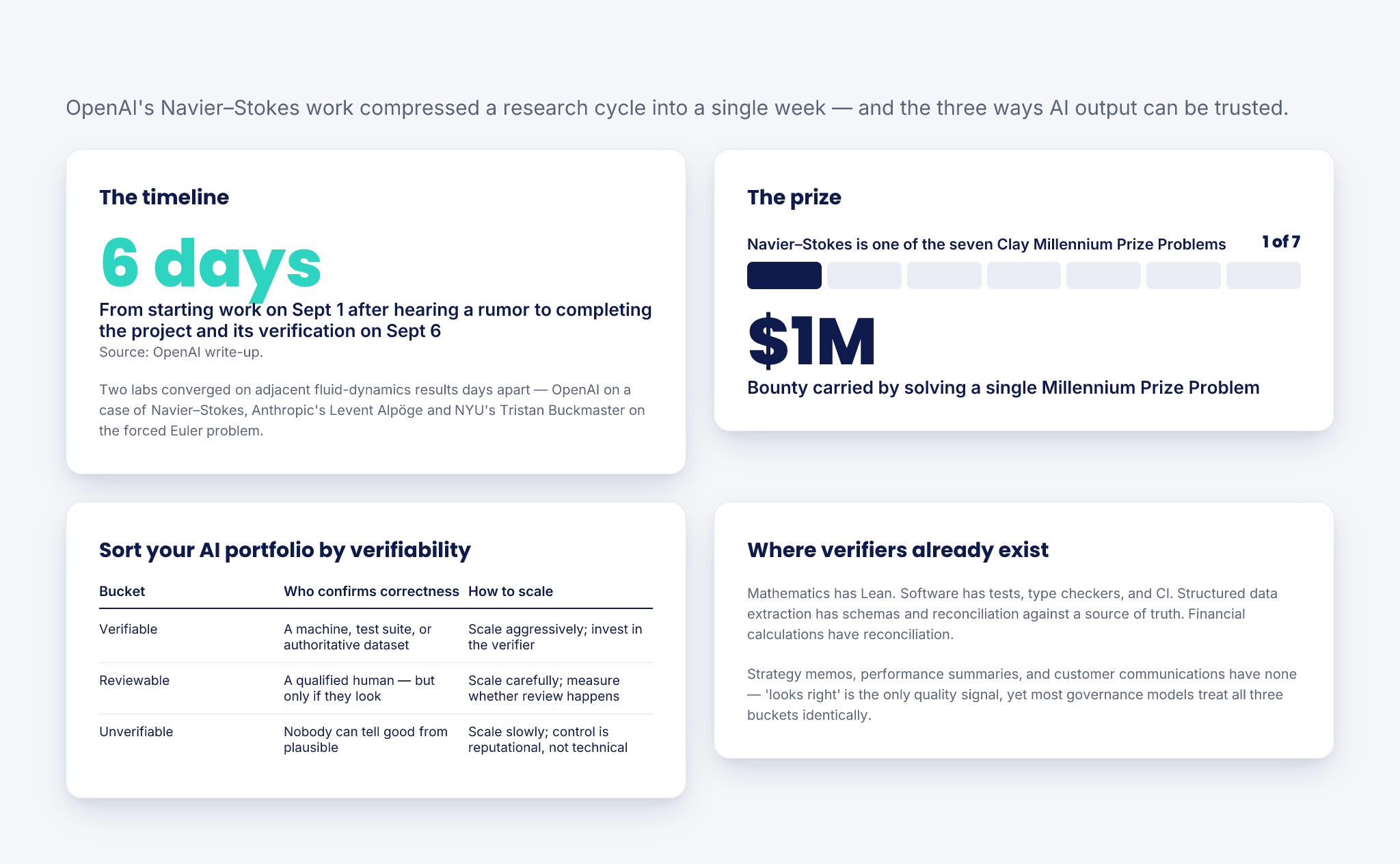
OpenAI published a claimed resolution of a case of the Navier–Stokes problem — one of the seven Clay Millennium Prize Problems, a set of questions so hard that solving one carries a million-dollar bounty and a permanent place in mathematical history. In its own write-up, OpenAI describes starting work on September 1st after hearing a rumor, completing the project and its verification on September 6th, then reaching out to the people behind the rumor: Levent Alpöge, an Anthropic employee, and Tristan Buckmaster, a mathematician at NYU, who had a resolution of the related forced Euler problem.
Days apart. Same territory. Two labs, one of which offered the other a joint announcement.
Nature covered the claim with the careful hedging the field deserves, and separate work made the pattern harder to dismiss: an arXiv preprint this month gives a new human proof of a result on the zeros of the Riemann zeta function that was "very recently announced by an internal research version of Claude" and then verified by human mathematicians. Anthropic also reported formalizing a proof of Fermat's Last Theorem.
Something has clearly shifted. But the thing that shifted is not the one most people will take away.
The claim isn't the news. The check is.
For three years, every AI capability announcement has followed the same script: a lab reports a number, the number is impressive, and nobody outside the lab can independently confirm what it means. Benchmark scores can be contaminated by training data. Demos are curated. "Expert-level performance" depends entirely on which experts, on which tasks, graded how.
Mathematics is different, and this is why it matters far beyond mathematics. A proof is either valid or it isn't. And with proof assistants like Lean — software that mechanically verifies each logical step — validity becomes a property a machine can confirm without trusting the author, the author's employer, or the author's press release.
OpenAI's write-up specifically references Lean verification of the result. That single detail does more for the credibility of the claim than any benchmark chart ever has. It converts "trust us" into "check it yourself."
This is the most important thing happening in AI evaluation right now, and it's happening almost by accident, in a domain most business leaders will skim past because it looks like pure academia.
Why a fluid-dynamics proof should change how you buy AI
Here is the uncomfortable comparison. A frontier lab can now produce a research-level mathematical result whose correctness is verified end to end by an automated checker. Meanwhile, most enterprises deploying AI to summarize contracts, triage support tickets, or draft clinical notes cannot answer a much simpler question: how do we know this output is right?
The gap isn't about model quality. It's about whether the domain has a verifier.
Mathematics has Lean. Software has tests, type checkers, and CI. Structured data extraction has schemas and reconciliation against a source of truth. Financial calculations have reconciliation. These are all domains where AI output can be checked, not just reviewed — and they are exactly the domains where AI deployment gets dramatically safer and scales further than anyone's intuition suggests.
The domains without verifiers are where the trouble lives. Strategy memos. Performance summaries. Customer communications. Anything where "looks right" is the only available quality signal. Those use cases aren't automatically bad, but they carry an entirely different risk profile, and most AI inventories don't distinguish between the two at all.
That distinction is one of the most practically useful ways to sort your AI portfolio:
- Verifiable outputs — a machine, test suite, or authoritative dataset can confirm correctness. Scale aggressively; invest in the verifier, not just the model.
- Reviewable outputs — a qualified human can catch errors, but only if they actually look. Scale carefully; measure whether review is really happening.
- Unverifiable outputs — nobody can efficiently tell a good answer from a plausible one. Scale slowly, and be honest that your control is reputational, not technical.
Most organizations have systems in all three buckets and a governance model that treats them identically.
The other lesson: concurrent discovery is now a weekly event
Don't skip past the timeline. Two independent teams, using frontier AI, converged on adjacent results in the same week — and one only learned of the other through a rumor.
For decades, simultaneous discovery has been a well-documented feature of science, but it usually plays out over months or years. When the tools compress a research cycle from years to days, near-simultaneous results stop being a curiosity and become the default. That has real consequences for anyone whose competitive advantage rests on being first: your window between insight and someone else's identical insight is narrowing fast.
If your AI strategy is built on the assumption that a clever application idea buys you eighteen months of lead time, revisit that assumption. What's defensible is increasingly the stuff AI can't replicate on demand — proprietary data, distribution, the operational discipline to actually deploy something reliably, and the institutional knowledge of where your AI systems are and what they're doing.
What to actually take from this
The headline reads "AI solves famous math problem." The lesson is quieter and more useful: the AI results you can trust are the ones that come with a verifier attached.
That's a standard you can apply immediately, without a mathematics degree. For every AI system in your organization, ask: what independently confirms this output is correct — and is that confirmation automatic, or is it a human who is quietly assumed to be checking?
If you can't answer for every system on the list, the first problem isn't verification. It's that you don't have the list.