

Anthropic reports Claude Opus 5 designed protein binders as well as or better than leading human experts — a signal that general-purpose AI is now doing real technical work, not just drafting emails.
For most of the AI era, the honest answer to "is it actually as good as an expert?" has been "no, but it's a helpful assistant." A new set of experiments from Anthropic complicates that story. In work the company published this month, its Claude Opus 5 model designed protein binders — molecules engineered to latch onto a specific target — that performed as well as, and in some cases better than, designs from leading human experts. A second experiment showed the same general-purpose model handling a specialized analytical chemistry task.
This matters because it isn't a narrow, purpose-built scientific tool. It's the same kind of model your team might already be using to summarize documents, now going toe-to-toe with specialists in a domain where results are expensive and slow to verify.
Why protein design is the interesting test
Plenty of AI systems have posted impressive scores on benchmarks — math problems, coding puzzles, trivia. The catch is that those tasks usually have a checkable answer sitting right next to the question. Real scientific work doesn't. You design something, then spend weeks and real money in a lab finding out whether it worked.
Protein binder design is exactly that kind of hard, verify-later problem. It sits at the center of drug discovery and diagnostics. Getting it right normally requires deep, hard-won expertise. So when a general-access model produces designs competitive with expert humans — and those designs hold up under experimental testing — it's a meaningfully different claim than "the model aced a quiz."
The analytical chemistry result points the same direction. These are domains where being confidently wrong is easy and being usefully right is hard. Clearing that bar is what makes the news worth paying attention to.
The counter-evidence you should hold at the same time
Here's where it gets genuinely interesting — because the same few weeks produced a strong reality check.
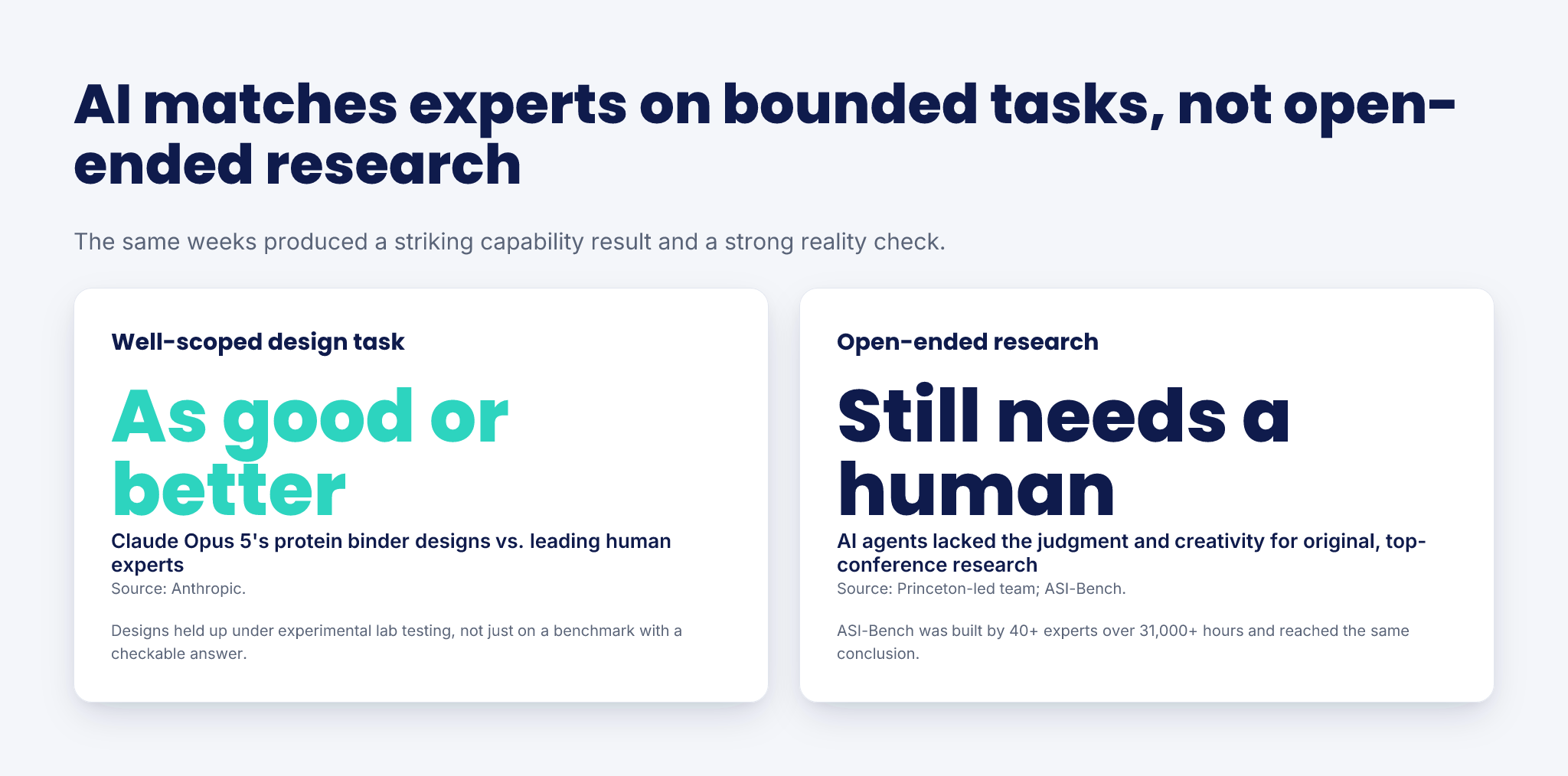
A multi-institution team led by researchers at Princeton, including AI Snake Oil co-author Sayash Kapoor, tested whether AI agents could conduct end-to-end research. Their finding: agents could handle the engineering problems — running experiments, avoiding getting stuck — but lacked the judgment and creativity to produce original research at the level of papers accepted to top machine-learning conferences. Reviewers noted the AI would happily chase fruitless paths a good scientist would have abandoned.
A separate benchmark effort, ASI-Bench — built by more than 40 experts over 31,000+ hours — reached a similar conclusion: today's systems "remain heavily dependent on human guidance and are still far from autonomously conducting end-to-end, project-level scientific research."
So we have two true things at once:
- On a well-scoped design task, a frontier model can match or beat experts.
- On open-ended, judgment-heavy research, AI still needs a human driving.
The gap between those two statements is the whole story.
What this actually means for teams
If you run an R&D function, a data team, or any group doing technical knowledge work, the takeaway isn't "replace your experts." It's "your experts just got a very capable collaborator for specific, bounded tasks — and it's your job to figure out which tasks."
A few practical implications:
- The frontier of "AI can do this well" is moving into specialist territory. Design, analysis, and generation tasks that felt safely human are now candidates for AI assistance. Assuming AI is only good for boilerplate is already out of date.
- The value is highest where verification is possible. Claude's protein designs were compelling because they were tested. When you deploy AI on a task, the first question is: how will we know if it's right? If you can't answer that, you're not deploying a collaborator — you're gambling.
- Judgment is still the human's job. The Princeton result is the guardrail. AI can generate options faster than any expert; it cannot yet reliably decide which options are worth pursuing. Keep humans on the "what should we even be doing" decisions.
- This is now a governance question, not just a tooling one. Once a model is influencing drug candidates, lab spend, or product designs, "which AI system produced this, and who signed off?" stops being a curiosity. It becomes something you need to be able to answer — for auditors, for regulators, and for your own sanity when a result turns out wrong.
The pattern underneath the headline
Strip away the specifics and you get a recurring shape for how AI capability actually lands in organizations. A frontier lab demonstrates something striking on a bounded task. The internet oscillates between "everything changes" and "it's all hype." The truth is narrower and more useful: AI is crossing the expert threshold on specific, verifiable tasks, while still failing at the messy, open-ended work around them.
Organizations that win with this won't be the ones with the loudest opinions about whether AI is "really intelligent." They'll be the ones who know exactly which AI systems they're running, what those systems are good and bad at, what they're spending, and where the human judgment layer sits. In other words, the ones who treat AI adoption as something to inventory, measure, and manage — not something to marvel at or dismiss.
The protein binders are the headline. The discipline to deploy models where they're strong and gate them where they're weak is the actual competitive advantage.