

Bridgewater's Greg Jensen wants frontier AI firms regulated like systemically important banks — a new argument that reframes AI risk as concentration risk.
For three years, the debate about regulating AI has been an argument about products. Is this model safe? Is that use case high-risk? Does the output need a label? The EU AI Act, Colorado's now-contested statute, the FTC's enforcement posture — all of it works at the level of the thing the model does.
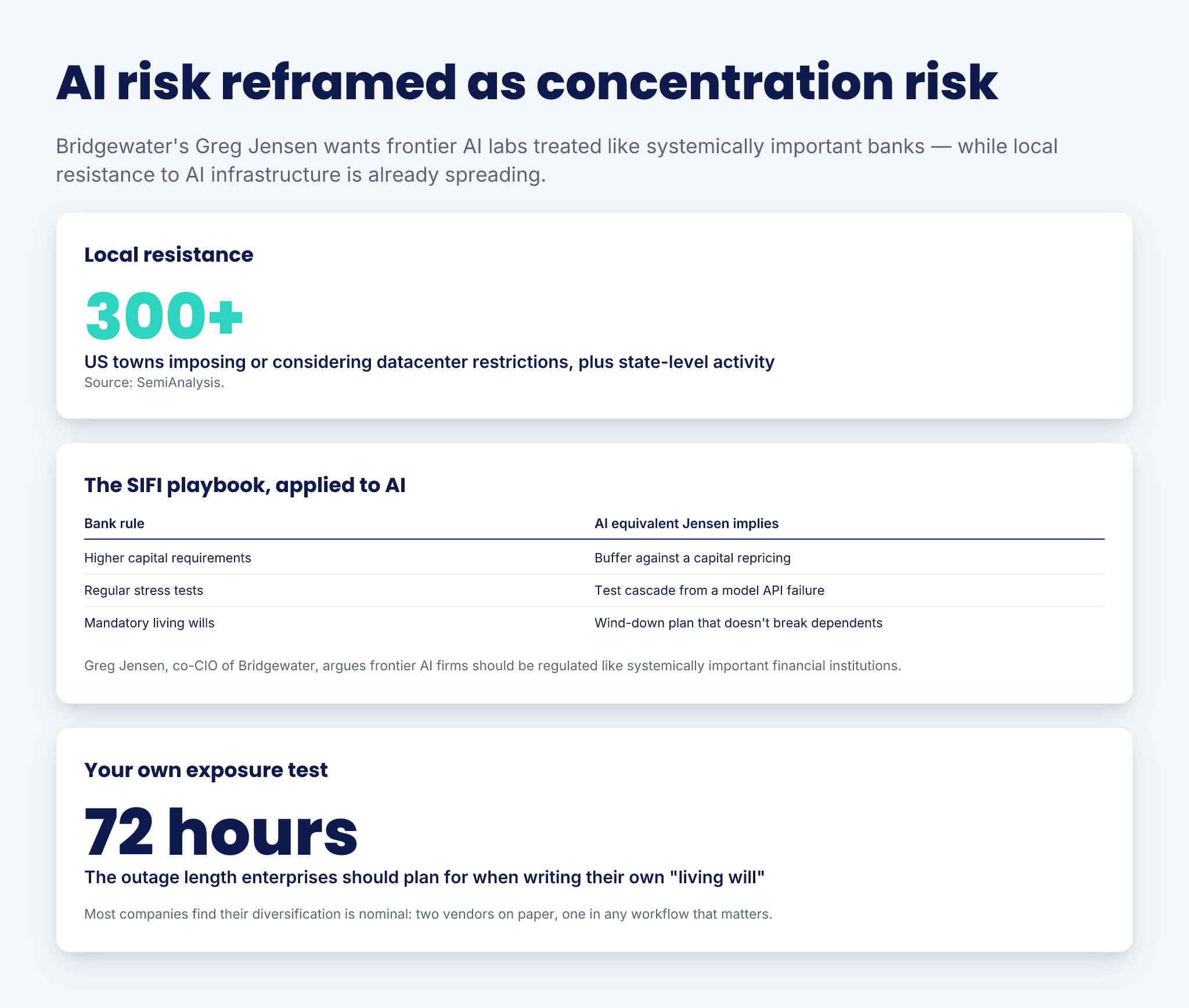
Greg Jensen, co-chief investment officer at Bridgewater Associates, has proposed a different frame entirely. In remarks reported by The Information, Jensen argued that frontier AI companies should be regulated the way systemically important financial institutions are: not because any individual product is dangerous, but because the failure of one firm would cascade through everything connected to it.
That's a meaningfully different claim, and it comes from an unusual direction. Jensen isn't a safety researcher warning about superintelligence, and he isn't a privacy advocate. He runs money at one of the world's largest hedge funds, and he's applying the mental model that finance built after 2008: some institutions become so entangled with the rest of the economy that their private risk decisions become everyone's problem.
What "systemically important" actually means
After the financial crisis, regulators created a designation for banks whose collapse would take the system down with them. Designated firms face higher capital requirements, regular stress tests, and — the part that matters most here — mandatory "living wills": documented plans for how the institution could be wound down without breaking everything attached to it.
Apply that lens to the AI market and the parallels get uncomfortable fast. A handful of labs supply the reasoning capability sitting underneath an enormous share of enterprise software. A smaller handful of cloud providers host them. A smaller handful still manufacture the chips. Capital is flowing in at a scale where a repricing wouldn't stay contained to venture portfolios. And the operational dependencies are now deep: when a major model API degrades, thousands of products degrade simultaneously, in ways their own customers can't diagnose.
The financial system learned that correlated exposure is invisible until it isn't. Everyone holds what looks like a diversified position, right up to the moment everyone discovers they were holding the same thing.
The backlash is already local
Jensen's argument lands in a moment when AI's physical footprint is generating political friction of its own. SemiAnalysis has been tracking the growing resistance to datacenter construction in the US — more than 300 towns, plus state-level activity, now imposing or considering restrictions. Their read is that this gap between industry expectation and public sentiment could widen heading into the 2026 midterms, as concerns about AI's broader impacts shape opinion.
That's the same story from a different angle. Whether it's a hedge fund CIO talking about systemic exposure or a county board voting down a substation, both reflect a recognition that AI has stopped being a software category and started being infrastructure — with the political and economic weight that comes with it.
Where this probably goes
I'm skeptical that a formal SIFI-style designation for AI labs arrives soon. The US federal posture has been explicitly deregulatory, the DOJ is actively suing to strike down state AI law, and the machinery for designating systemically important non-banks has been politically contested for a decade. Jensen's proposal is a provocation more than a forecast.
But provocations from serious capital allocators tend to show up later in how institutions behave, even when the regulation never materializes. The more likely near-term outcome is that concentration risk gets priced and managed privately — by insurers, by boards, by large buyers writing it into contracts — before any regulator formalizes it.
Which means the interesting question isn't whether OpenAI gets designated systemically important. It's whether your organization has quietly become systemically dependent on one.
What this means if you're buying, not building
Most enterprises will never be the subject of this debate. They'll be the downstream exposure in it. Three things worth doing regardless of what regulators decide:
- Know your actual provider concentration. Not "we use OpenAI and Anthropic" — the real number. Which systems, which workflows, which revenue-bearing processes route through which model provider. Most companies discover their diversification is nominal: two vendors on paper, one in any workflow that matters.
- Distinguish substitutable from entangled. A summarization feature can swap models in an afternoon. An agent with tuned prompts, tool definitions, evaluation suites, and six months of behavioral tuning cannot. The second category is where your real lock-in lives, and it rarely appears in procurement records.
- Write your own living will. If your primary provider had a 72-hour outage, a pricing shock, or a legal injunction, what degrades and in what order? Very few teams can answer this, and the answer is usually cheap to produce and expensive to skip.
None of that requires a view on whether Jensen is right. It's the same discipline any organization should have around a critical single-source supplier — a discipline AI adoption largely skipped, because the tools arrived faster than the procurement process could follow.
The useful part of Jensen's framing isn't the policy prescription. It's the reminder that AI risk isn't only about what a model outputs. It's also about what happens to you when the thing you built on top of moves — in price, in policy, in availability, or in ownership. That risk doesn't live in a model card. It lives in your inventory, your spend, and your dependency map. If you can't see those clearly, you can't see the exposure at all.