

A compromise of the open-source LiteLLM gateway exposed API keys and credentials across 2,500+ organizations — proving your AI supply chain risk lives in infrastructure you never inventoried.
Most AI governance programs are built around models. They track which large language models are approved, what data those models touch, and who signed off on the use case. That focus is understandable — and dangerously incomplete. The systems that broke this month weren't the models. They were the pipes.
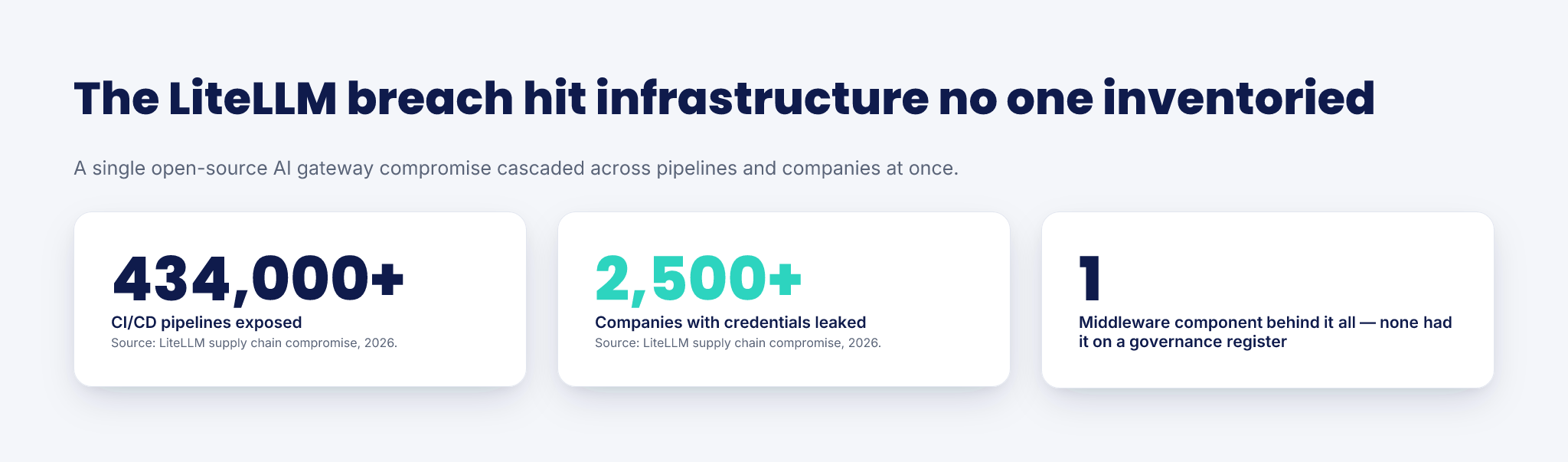
A supply chain compromise of LiteLLM — a widely used open-source framework that proxies requests to dozens of AI providers — exposed credentials, API keys, and configuration secrets across more than 434,000 CI/CD pipelines and over 2,500 companies. It is being called the largest AI infrastructure breach of 2026 so far. And almost none of the affected organizations had LiteLLM on any governance register, because it isn't a "model." It's middleware.
That gap is the whole story.
Why AI middleware is a governance blind spot
Enterprise AI rarely calls a model provider directly. Between your application and the model sits a growing stack of connective tissue: gateways, proxies, routers, caching layers, prompt frameworks, vector databases, orchestration libraries, and observability agents. Much of it is open source, pulled in by developers to solve a real problem quickly — unified billing across providers, rate limiting, failover, cost tracking.
This layer holds the crown jewels. To route requests, a gateway like LiteLLM must store the API keys for every downstream provider. To track spend, it logs usage. To debug, it captures prompts and completions — which often contain customer data, source code, and internal reasoning. A single compromised component in this position doesn't leak one system. It leaks the keys to all of them.
Three properties make this layer especially hard to govern:
- It's invisible to model-centric inventories. If your register only lists "GPT-5" and "Claude," you have no field for the proxy that talks to both.
- It's introduced bottom-up. Developers add a library in an afternoon; no procurement review, no vendor questionnaire, no ownership record.
- It concentrates secrets. The efficiency that makes a gateway attractive — one place to manage everything — is exactly what makes its compromise catastrophic.
The pattern is bigger than one library
LiteLLM is not an isolated failure. In the same window, security researchers disclosed an API vulnerability across OpenAI, Anthropic, and Google that leaked internal reasoning logs — again exposing keys, passwords, and access tokens. Evaluation environments at multiple frontier labs were found connected to the public internet through simple misconfigurations. The common thread isn't malicious models. It's operational plumbing that was never treated as a governed asset.
For risk teams, this reframes AI supply chain risk. It's not only "which vendor's model are we using." It's:
- Which open-source AI components are in our build pipelines and runtime?
- Where do those components store or transit provider credentials?
- Who owns each one, and who patches it?
- What data — prompts, outputs, PII — passes through them and is logged?
Regulators are already moving in this direction. The Financial Stability Board's guidance tells institutions to fold AI risk into existing third-party and cybersecurity programs. The UK's CMA has made clear you cannot outsource accountability to an AI vendor. When credentials leak through a component you didn't know you ran, "we didn't build it" is not a defense — to a regulator, a plaintiff, or a board.
Turning the breach into a control
The remediation for the current incident is straightforward and urgent: rotate every credential that touched an affected gateway, audit integration points, and pin dependency versions. But firefighting one breach doesn't fix the blind spot that made it a surprise. Governance does. Here is where to focus.
- Inventory the full AI stack, not just the models. Your systems inventory needs first-class entries for gateways, proxies, orchestration frameworks, and vector stores — with an owner, a data-flow description, and a credential map for each. If it can hold or transit an API key, it belongs on the register.
- Treat open-source AI components as third parties. A library that concentrates secrets deserves the same scrutiny as a SaaS vendor: known-vulnerability monitoring, a named accountable owner, and a patch SLA. Bottom-up adoption is fine — ungoverned adoption is not.
- Map where secrets and sensitive data live. You cannot protect credentials you can't locate. For each AI system, document what secrets it holds, what data it logs, and where those logs go. This is also what makes incident response fast instead of frantic.
- Connect the gap to an initiative. An inventory that surfaces an unmanaged, credential-holding component is only useful if it triggers action — rotation, isolation, replacement, or hardening — with an owner and a deadline. Measuring maturity across security and third-party risk turns a scary headline into a prioritized backlog item.
The takeaway
The LiteLLM breach is a preview, not an anomaly. As enterprises wire models into real workflows, the connective infrastructure multiplies — and each new component is a potential single point of failure holding every key at once. The organizations that weather the next one won't be those with the best models. They'll be the ones who inventoried the plumbing, assigned it an owner, and knew exactly which credentials to rotate before breakfast.
Model governance without infrastructure governance is a locked front door next to an open window. This month, 2,500 companies found the window.
Start where governance always starts: know what you have. Then you can defend it.