

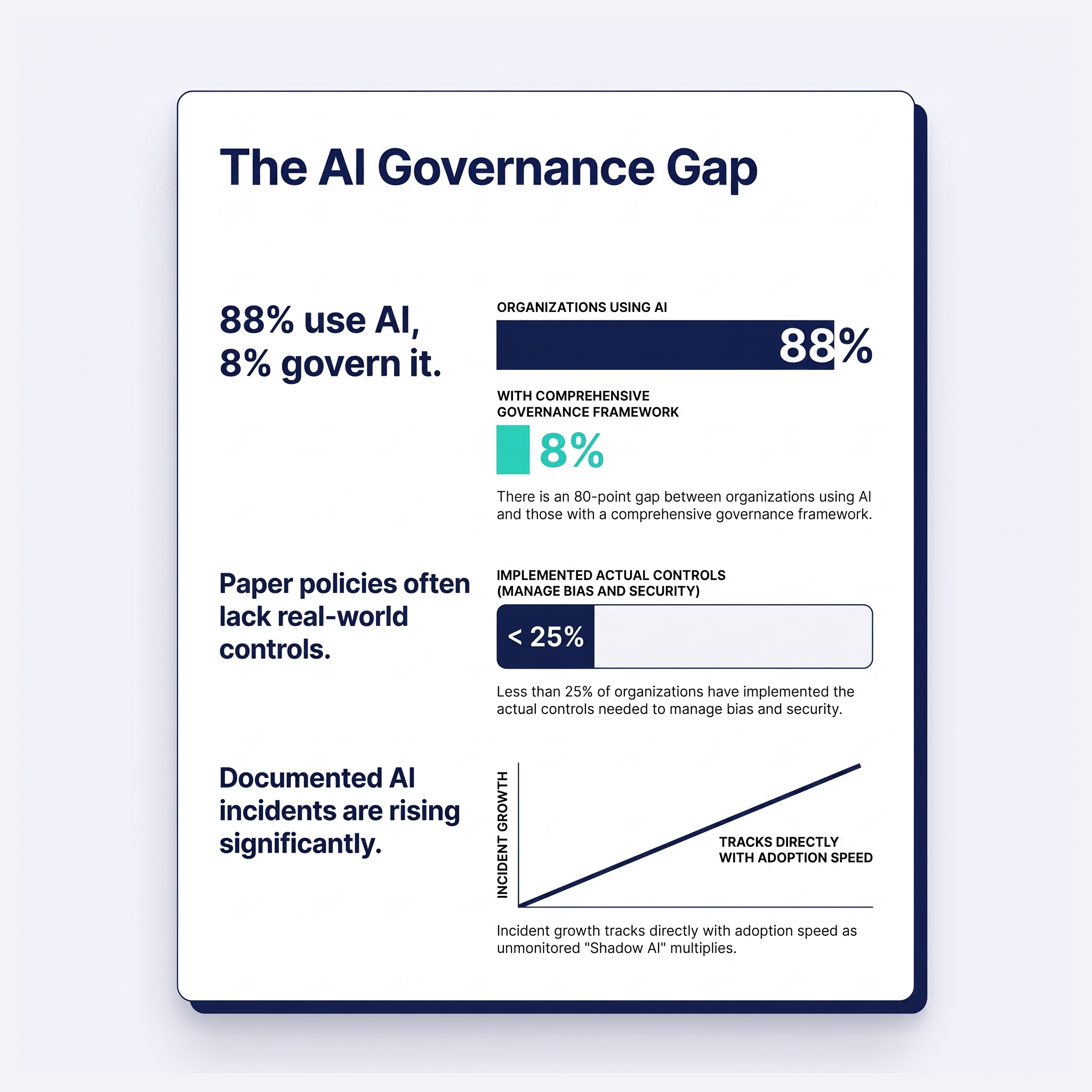
There's a number that should stop every executive team cold: 88% of organizations use AI. Only 8% have a comprehensive AI governance framework.
That 88% figure comes from Aon's most recent research; the 8% comes from Economist Impact. Eighty-eight percent versus eight percent — not a shortage of AI adoption, not a shortage of ambition — is the defining risk of enterprise AI in 2026.
Most conversations about AI still center on capability: what the models can do, how fast they're improving, which vendor to pick. That conversation made sense in 2023. It doesn't make sense anymore. The technology question has largely been answered. Nearly every company that wanted to use AI is now using it. The unanswered question — the one almost nobody has a good answer to — is whether anyone actually knows what's running, who approved it, what data it touches, and what happens when it fails.
That's not a hypothetical. It's the current state of most mid-market organizations.
Adoption without oversight isn't a phase — it's the default state
There's a comforting story leaders tell themselves: governance is the next step, something to build once the initial wave of AI experimentation settles down. Give it a year. Let the pilots mature. Governance will follow naturally.
It doesn't happen naturally. It has to be built.
The 88/8 gap didn't emerge because organizations are early in a maturity curve that's about to correct itself. It emerged because adoption and governance follow entirely different paths inside a company. Adoption happens bottom-up — a marketing manager tries a new writing tool, an analyst wires up an API, a team lead approves a chatbot for customer support because it solves a problem this week. Governance, by contrast, requires top-down structure: an inventory of what's in use, a policy for what's allowed, a process for reviewing risk, and someone accountable for the answer when a regulator or a board member asks "what AI systems do we run, and how do we know they're safe?"
Nothing about the first path naturally produces the second. Left alone, the gap doesn't close. It widens, because every month adds more AI tools, more use cases, and more surface area — with no corresponding increase in oversight.
IBM's research captures this same disconnect from a different angle: a large majority of organizations claim to have a clear AI governance framework on paper, but fewer than a quarter have actually implemented the controls needed to manage bias, transparency, and security risk in practice. In other words, even the companies that think they've closed the gap usually haven't. Governance on a slide deck and governance running in production are two different things, and the distance between them is where the real exposure sits.
Why this gap is more expensive than it looks
None of this would matter much if the downside were purely theoretical. It isn't. The cost of the AI governance gap shows up in a few concrete, increasingly visible ways.
Regulatory exposure is compounding. The EU AI Act is now enforceable, with penalties for prohibited practices running into the tens of millions of euros or a meaningful percentage of global turnover. A growing number of jurisdictions are following the same playbook. Organizations that can't produce a current inventory of their AI systems and the risk level of each one are not in a defensible position when a regulator asks. Board and investor scrutiny has caught up. AI risk disclosures among large public companies have risen sharply over the past two years, reflecting a shift where boards now expect a straight answer to "what's our AI exposure" the same way they expect one for cybersecurity or financial controls. Executives without an answer are increasingly the exception, not the norm — and increasingly conspicuous for it. Shadow AI is a silent multiplier. Every unsanctioned tool, every "just testing it" integration, every AI feature quietly switched on inside existing software adds to a surface area nobody is tracking. Each one is a small decision made without governance attached. The accumulation is where the real risk lives. Incidents are rising. Documented AI-related incidents increased significantly year over year, a trend that tracks almost exactly with the acceleration in adoption. More systems in production, with less oversight per system, produces exactly the outcome you'd expect.None of this requires a company to be reckless. It just requires a company to be normal — to adopt AI the way virtually every organization has, quickly and informally — without building the governance layer that adoption at this speed actually demands.
What this actually looks like inside a company
Abstract statistics are easy to nod along to and easy to forget. So picture the more concrete version.
A mid-market company — call it 2,000 employees, no dedicated AI team — has, over the past 18 months, accumulated AI capability the way most companies do: an AI writing assistant rolled out by marketing, a coding copilot adopted by engineering, a customer support chatbot layered on top of the helpdesk, a handful of AI features quietly switched on inside existing SaaS tools nobody explicitly evaluated, and at least one workflow automation built by an enthusiastic analyst using an API key they requested themselves.
Ask that company's leadership how many AI systems are currently in use, and you'll get a shrug, followed by a partial list, followed by "let us check and get back to you." Ask which of those systems touch customer data, which ones a regulator would classify as higher-risk, or who signed off on each one, and the partial list gets even shorter. This isn't a hypothetical edge case — it's close to the median condition of companies in this segment right now, which is exactly why the 88/8 gap exists at scale rather than in isolated pockets.
None of this happened because anyone was careless. It happened because AI adoption is fast, distributed, and low-friction by design — that's precisely what makes it valuable — while governance requires centralized visibility that nobody was asked to build. The gap isn't a character flaw. It's a structural mismatch between how AI gets adopted and how oversight gets built, and it will keep widening in every organization that doesn't deliberately close it.
What the 8% are doing differently
The organizations that fall inside that 8% didn't get there by slowing down AI adoption. They got there by treating governance as infrastructure rather than paperwork. A few patterns show up consistently:
They start with visibility, not policy. You cannot govern what you cannot see. The organizations with real governance maturity built a live inventory of every AI system in use — internal tools, vendor products, embedded features, agentic workflows — before they wrote a single policy document. Policy without visibility is a guess. They separate risk tiers instead of applying one rule to everything. A mature governance program doesn't treat a low-risk internal drafting tool the same way it treats a customer-facing model making credit or hiring decisions. Effort gets concentrated where the risk actually is. They assign clear ownership. Ambiguity about who owns AI governance — is it IT, legal, compliance, a dedicated team? — is one of the most common reasons programs stall. The organizations that move fastest have picked an answer and given that group real authority. They measure maturity as an ongoing state, not a one-time project. Governance isn't a checkbox that gets ticked once. It's tracked, reported, and revisited the same way financial controls are, because the underlying risk — what tools are in use, what data they touch — keeps changing.None of these practices require a large compliance department or a six-figure consulting engagement. They require structure and a starting point.
Closing the gap starts with one question
If there's a single diagnostic question that separates the 88% from the 8%, it's this: could your organization produce, right now, a complete and current list of every AI system in use, who owns it, what data it touches, and what risk tier it falls into?
Most organizations can't answer that question with any confidence. That's not a failure of leadership — it's the predictable result of adoption outpacing infrastructure. But it is fixable, and it doesn't require the multi-quarter governance overhaul that the word "framework" tends to conjure.
Evum was built around that starting point. Instead of asking teams to fill out spreadsheets or commission an audit, Evum gives you a living inventory of your AI systems, a maturity view of where your governance program actually stands, and a structured path to close the gap — all inside one platform you can start using today. If you're ready to see where your organization actually falls between that 88% and that 8%, you can get started at evum.ai.
The organizations that close this gap in the next twelve months won't just reduce their regulatory and reputational risk. They'll be the ones still standing when the next wave of AI enforcement and scrutiny arrives — able to answer the question everyone else is still scrambling to figure out how to ask.