

Most executives picture an AI governance framework as a compliance binder that gets opened once a year, right before an audit. That's the wrong mental model.
A framework, in practice, is just an operating system for how your organization makes decisions about AI: who owns the risk, how new tools get approved, what gets measured, and what happens when something goes wrong. Companies that treat it that way build something durable. Companies that treat it as a paperwork exercise end up with a policy nobody follows and a false sense of security.
Here's the plain-English version — what these frameworks actually contain, why boards are suddenly asking about them, and how a mid-market company can adopt one without hiring a full compliance department.
Why this is on your desk now
Governance used to be optional homework. It's quickly becoming a baseline expectation, for three reasons.
First, regulators are pointing to existing frameworks instead of writing new rules from scratch. Colorado's AI Act allows companies to use alignment with the NIST AI Risk Management Framework or ISO/IEC 42001 as an affirmative defense against liability for AI-related harm, and Texas offers similar credit for NIST alignment. That's a direct legal incentive to have a documented framework in place before something goes wrong, not after.
Second, procurement has started asking the question for you. A growing share of enterprise buyers now build AI governance evidence into vendor due diligence — proof of an AI inventory, a risk register, and documented human oversight — before they'll sign. If you sell into enterprise accounts, this shows up as a slower deal cycle the moment a security questionnaire lands in your inbox.
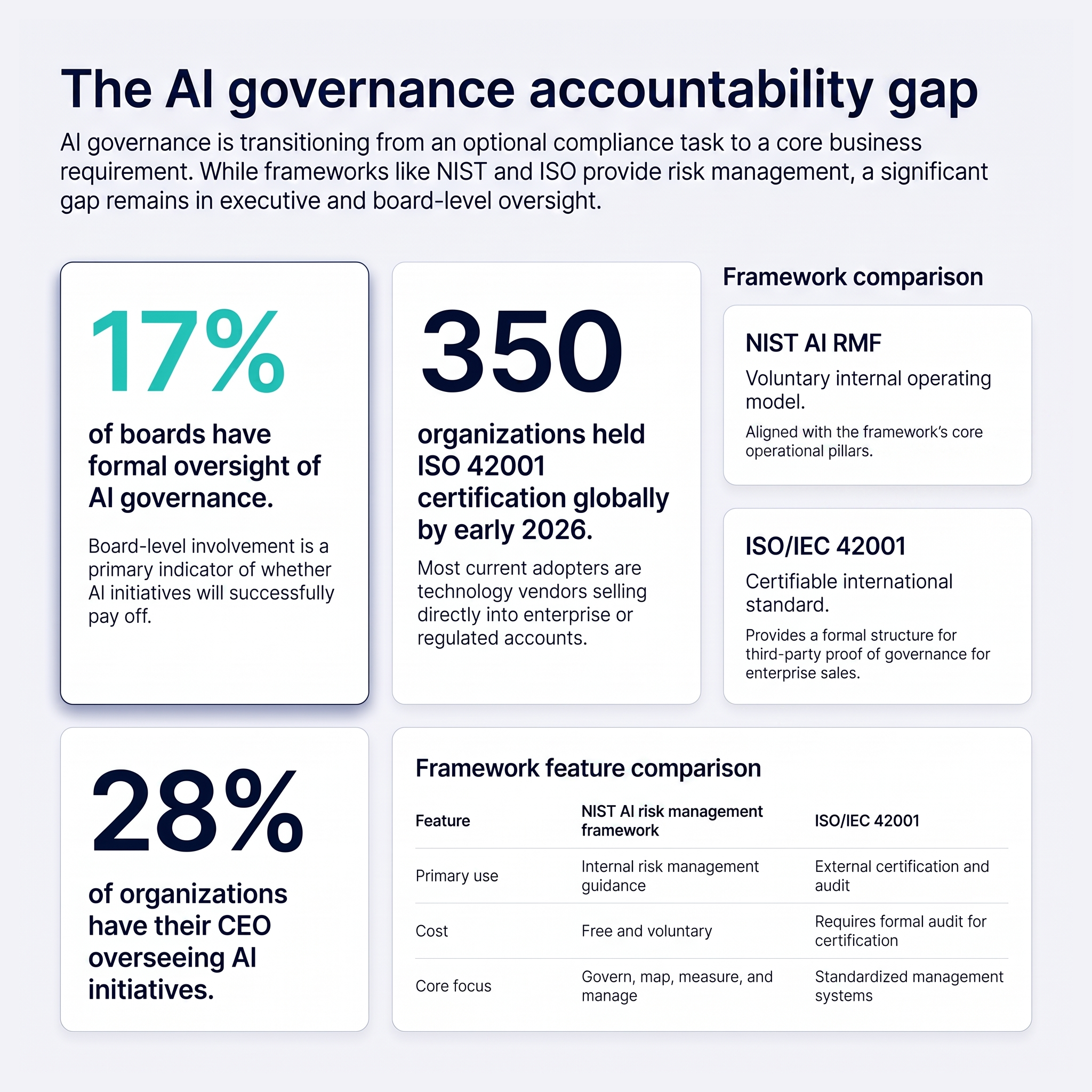
Third, the accountability gap is visible at the top. Recent survey data from McKinsey found that only 28% of organizations have their CEO overseeing AI governance, and just 17% have board-level oversight — even though CEO-level ownership is one of the factors most correlated with AI initiatives actually paying off. Boards are starting to notice that gap and ask their own CIOs and CTOs to close it.
None of this requires a Fortune 500 budget. It requires picking a recognized structure and actually running it.
The two frameworks everyone references (and how they differ)
You'll hear two names constantly in this space. They're not competitors — they solve different problems.
NIST AI Risk Management Framework (AI RMF). Free, voluntary, and published by the U.S. National Institute of Standards and Technology. It organizes AI risk management into four functions:- Govern — the policies, roles, and decision rights that make everything else possible. Who approves a new AI tool? Who's accountable if it fails?
- Map — documenting what AI systems exist, what they're used for, and what could go wrong with each one. This is your inventory, in framework language.
- Measure — evaluating those systems against defined metrics: accuracy, bias, drift, security.
- Manage — ongoing monitoring, incident response, and continuous improvement once systems are live.
These aren't sequential stages you complete once. They run continuously and feed back into each other as your AI footprint changes.
ISO/IEC 42001. The first international, certifiable management-system standard built specifically for AI, published in December 2023. Where NIST AI RMF is guidance you adopt at your own pace, ISO 42001 is something you can actually get audited and certified against — the same way companies pursue ISO 27001 for information security. Certification is still an early-adopter signal: public estimates put the number of organizations holding an ISO 42001 certificate at roughly 350 worldwide as of early 2026, concentrated heavily among technology vendors and firms selling directly into enterprise and regulated accounts.The practical relationship between the two: NIST AI RMF gives you the operating model, and ISO 42001 gives you a certifiable structure to prove you're running it. Most mid-market companies start with NIST-aligned practices internally, then consider ISO 42001 certification later if enterprise sales or EU market access makes third-party proof worth the investment.
A mid-market scenario
Picture a 900-employee logistics company — call it Northfield Freight. Over the past eighteen months, dispatch started using an AI routing tool, customer service picked up a chatbot vendor, and finance quietly signed up for an AI-powered forecasting add-on inside their ERP. None of these went through a formal review. Each team picked the tool that solved its own problem.
Then a large retail customer's procurement team sends over a security questionnaire ahead of a contract renewal. Question fourteen asks for the company's AI governance framework and a current AI system inventory. Nobody at Northfield can produce either document, because nobody has been assigned to maintain them. The renewal stalls for six weeks while IT and legal scramble to reconstruct a list of tools nobody centrally tracked.
Northfield didn't need a hundred-page governance manual to avoid this. It needed one person accountable for AI oversight, a simple inventory of AI systems, and a lightweight version of the Govern-Map-Measure-Manage cycle applied consistently. That's the entire gap between "flying blind" and "audit-ready."
Building a lightweight framework: four practical steps
You don't need to implement NIST AI RMF or ISO 42001 in full to get real protection. A defensible starting framework, even for a company Northfield's size, comes down to four moves:
- Assign a single accountable owner. Not a committee — one named person (often the CIO, CTO, or a designated AI governance lead) who owns the framework and reports on it. Diffuse ownership is the most common reason governance programs quietly die.
- Build and maintain a real AI inventory. Every AI tool in use, who owns it, what data it touches, and what it's used for. This single artifact answers most of what a procurement questionnaire or regulator will ask first.
- Set a review cadence, not a one-time audit. Govern, Map, Measure, and Manage are meant to run continuously — a quarterly review of the inventory and risk register keeps the framework alive instead of letting it fossilize the day after it's written.
- Map to one recognized standard, even informally. You don't need certification to benefit from structure. Aligning your internal policy language to NIST AI RMF's four functions means that if a customer, regulator, or acquirer asks for evidence later, you're translating your existing work rather than starting over.
The framework is the foundation, not the finish line
A governance framework doesn't slow AI adoption down — it's what lets a company keep adopting AI without losing track of what it's running or who's accountable for it. The organizations that get this right treat it the way Northfield eventually did after that stalled renewal: as living infrastructure that gets checked quarterly, not a document that gets filed and forgotten.
The hardest part isn't picking a framework. It's building the muscle to keep it current as your AI footprint keeps growing — which is exactly the kind of ongoing tracking that's hard to do by hand in a spreadsheet.
See how Evum turns this framework into a running system — one inventory, one risk register, one maturity score, always current. Request a demo.