

A Meta class-action and new state laws show that automated employment decisions are now a top-tier AI governance and litigation risk for enterprises.
Former Meta employees have filed a federal class-action lawsuit alleging the company used an internal AI agent — reportedly called "Metamate" — to score and rank workers for mass layoffs. The plaintiffs claim the system disproportionately targeted employees with disabilities and those on protected leave. Whatever the outcome, the case marks a turning point: automated decision-making in HR has moved from a theoretical fairness concern to a live courtroom liability.
For compliance and risk leaders, the lesson is not "don't use AI in HR." It's that employment decisions are among the highest-stakes AI use cases in your organization — and most companies have no idea how many of them are already running.
Why employment AI is uniquely dangerous
AI touches the employee lifecycle at nearly every stage: résumé screening, candidate ranking, interview scoring, performance evaluation, promotion recommendations, and — as the Meta suit alleges — layoff selection. Each of these is a decision about a person's livelihood, which is exactly why regulators and plaintiffs' attorneys are watching closely.
Three factors make these systems especially risky:
- Protected classes are implicated by default. Employment decisions intersect with age, disability, race, gender, and leave status. A model that optimizes for a proxy variable can produce disparate impact without anyone intending discrimination.
- The decisions are consequential and hard to reverse. A rejected candidate or a laid-off worker has a concrete, documentable harm — the raw material for a lawsuit.
- Explainability is often absent. When a manager can't articulate why the system ranked someone the way it did, the organization can't defend the decision or prove it was non-discriminatory.
The regulatory net is tightening fast
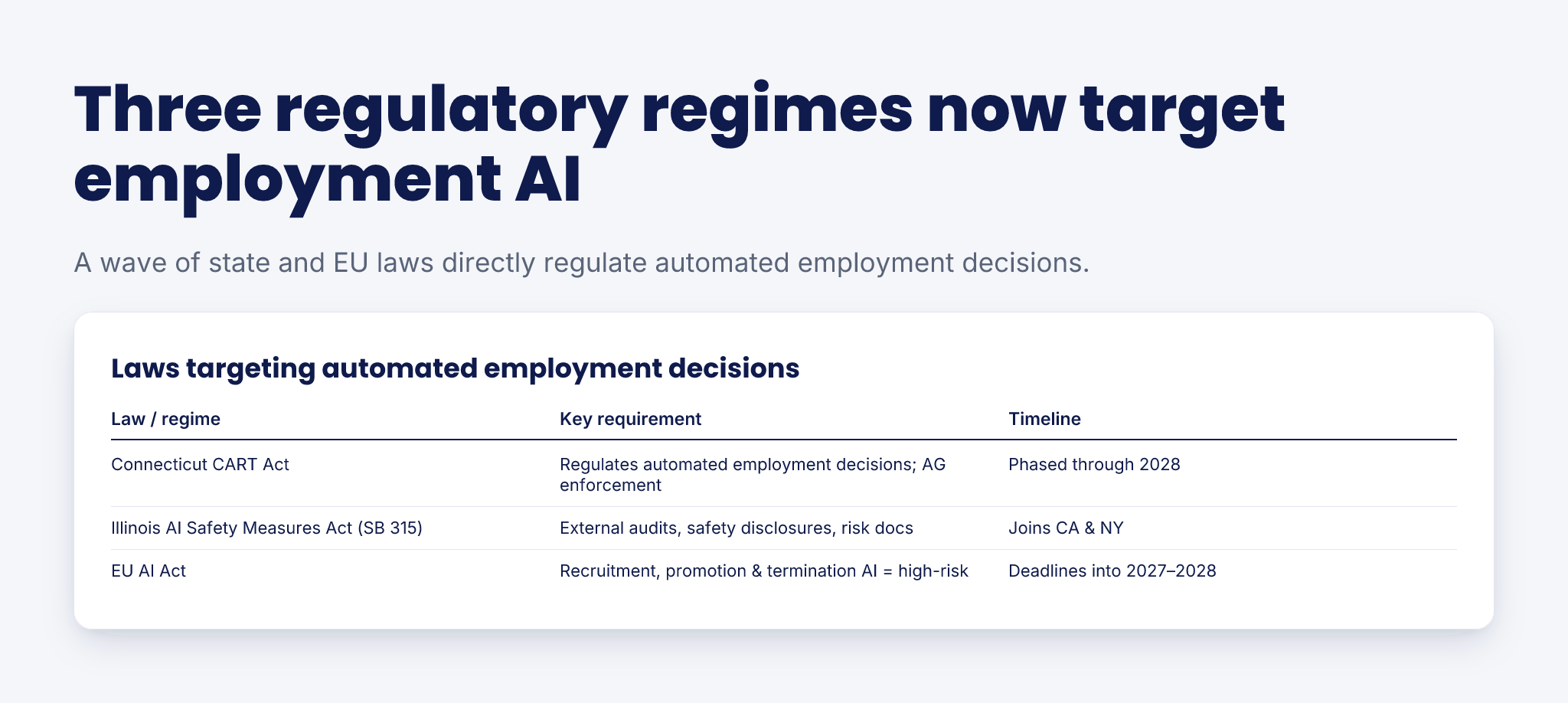
The Meta case isn't happening in a vacuum. A wave of state laws now specifically targets automated employment decision-making (often abbreviated ADMT):
- Connecticut's CART Act — the Artificial Intelligence Responsibility and Transparency Act — introduces a phased compliance timeline through 2028 and directly regulates automated employment-related decisions, synthetic media, and frontier models, with enforcement led by the state Attorney General.
- Illinois' AI Safety Measures Act (SB 315) joins California and New York in requiring external audits, safety disclosures, and risk-management documentation for powerful AI systems.
- The EU AI Act classifies AI used in recruitment, promotion, and termination as high-risk, triggering obligations around risk management, data governance, human oversight, and record-keeping — with high-risk deadlines now extended into 2027 and 2028 under the Digital Omnibus, but the obligations firmly on the horizon.
Add the FTC's aggressive posture on "AI washing" and existing anti-discrimination law (Title VII, the ADA, the ADEA), and you have overlapping regimes that all point to the same requirement: you must be able to inventory, justify, and monitor any AI that influences employment outcomes.
What "good governance" looks like for employment AI
Defending against a Meta-style claim starts long before litigation. It starts with knowing the system exists and being able to prove it was governed. Practical controls include:
- Inventory every employment-relevant AI system. This includes vendor tools inside your HRIS or ATS, not just models you built. If a résumé-screening feature ships inside a SaaS platform, it's still your decision and your liability.
- Classify by risk tier. Map each system against high-risk criteria — EU AI Act, state ADMT laws, and your own internal thresholds. Employment use cases should almost always land in your highest tier.
- Run bias and disparate-impact testing. Test outcomes across protected classes before deployment and on a recurring schedule after. Document the methodology and the results.
- Guarantee meaningful human oversight. A human "rubber stamp" on an opaque ranking is not oversight. Reviewers need the ability to understand, question, and override the model's output.
- Preserve documentation and audit trails. The Meta plaintiffs are demanding records. Assume every employment decision may one day need to be reconstructed — including model version, inputs, and the human sign-off.
- Flow requirements down to vendors. As Fannie Mae's new AI governance rules illustrate, regulators increasingly expect subcontractors and vendors to meet equivalent standards. Contractual commitments and evidence of vendor testing belong in your governance record.
The shadow-AI problem in HR
Here's the uncomfortable part: much of this AI enters the enterprise without formal approval. A recruiter uses a generative tool to draft screening criteria. A manager pastes performance notes into a chatbot to "help decide" who to cut. A vendor quietly ships an AI scoring feature in a product update. None of it appears in a policy binder — but all of it can produce a discriminatory outcome the company will have to defend.
This is why a governance program can't rely on self-reported spreadsheets. You need a living inventory that captures every AI system, its risk classification, its owner, and its control status — and that turns identified gaps into prioritized remediation work before they become exhibits in a lawsuit.
The bottom line
The Metamate lawsuit is a preview of the enforcement and litigation wave heading toward any organization that lets AI influence hiring, evaluation, or termination. The question a court, a regulator, or a state attorney general will ask is simple: Did you know this system was making employment decisions, and can you prove you governed it?
For most enterprises today, the honest answer is no. Closing that gap — inventorying employment AI, classifying its risk, testing for bias, and maintaining defensible documentation — is no longer a nice-to-have. It's the difference between a governable program and a class-action exhibit.
Map your employment-relevant AI systems, measure their governance maturity, and turn the gaps into prioritized initiatives before the next lawsuit names your company.