

A new working paper finds PhD graduates who used AI to write their dissertations are more likely to take industry jobs — a quiet signal about what AI is doing to research careers.
Buried in a National Bureau of Economic Research working paper is a number that deserves more attention than it's gotten: roughly 30% of STEM PhD dissertations submitted in the US this year contain AI-generated text, based on a review of abstracts in an online database going back to 2019. That alone is a striking adoption curve for a norm-bound, credential-heavy corner of the economy. But the more interesting finding sits one layer deeper — the paper, reported by Nature, found that graduates who used AI to help write their dissertations were more likely to go into industry and less likely to stay in academia.
Sit with that for a second, because the obvious reading — "AI makes people lazier researchers, so they wash out of research careers" — is probably the wrong one. A more plausible story is that AI is quietly re-sorting people by what they're actually good at, or what they actually want. Writing a dissertation is, in large part, a performance: you're not just doing research, you're proving you can produce a very specific kind of document, in a very specific voice, under a very specific set of norms that exist mostly to signal you belong in academia. If AI tools let some students clear that bar faster and with less friction, the students who lean on them hardest might be exactly the ones who were less invested in the performance to begin with — and more interested in getting to a job where the output matters more than the ritual.
That reframes the finding from "AI degrades research quality" to something more useful for anyone running an organization: AI changes who self-selects into which paths, well before anyone writes a policy about it.
Why this matters beyond academia
Swap "dissertation" for "slide deck," "code review," or "client memo," and the dynamic should sound familiar. Every organization has its own version of the credentialing ritual — the internal proof-of-competence work that exists partly to get something done and partly to demonstrate who did it, and how. AI tools are already compressing that second part. The question this research surfaces, and that most companies haven't asked themselves yet, is: when the ritual gets faster, who stays and who leaves — and is that the sorting you want?
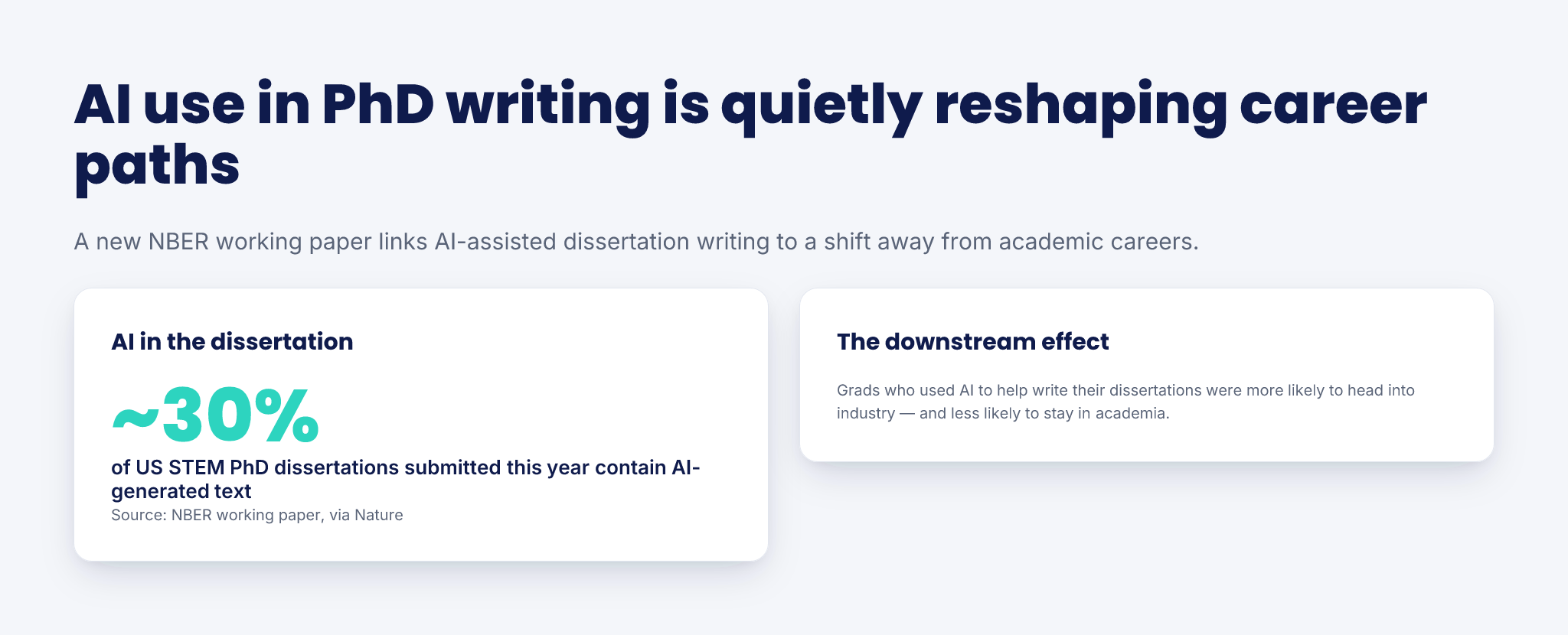
This isn't a hypothetical for evum's own audience. If your organization is tracking AI adoption only by usage counts and spend, you're measuring the wrong half of the story. The other half is behavioral: which teams are leaning on AI heavily enough that it's changing their trajectory, their output mix, or their retention — and whether that's a trend you want to encourage or a blind spot you want to catch early. A 30% AI-assistance rate in high-stakes STEM dissertations, arrived at with essentially no institutional oversight, is a preview of what happens inside any organization that doesn't have a way to see how deeply AI has worked its way into the actual substance of people's work, not just the tools on an approved list.
It's also worth being honest about the limits of the finding itself. The paper is a working paper — not yet peer reviewed — and it can't fully untangle cause from selection: it's entirely possible that people already leaning toward industry careers were simply more comfortable reaching for AI tools in the first place, rather than AI use causing the career shift. The researchers aren't claiming otherwise, and neither should we. What the data does support, carefully stated, is a correlation worth taking seriously: AI assistance and career trajectory are moving together in a way that wasn't true a few years ago.
The real takeaway for leaders
Most AI governance conversations focus on risk: data leakage, hallucinated outputs, regulatory exposure. Those are real. But this finding points at a softer, slower-moving effect that's just as consequential — AI tools reshape who does which kind of work, and who sticks around to keep doing it. A research lab that doesn't notice AI quietly filtering its PhD pipeline toward industry is making a talent decision by accident. A company that doesn't notice which of its best people are offloading the "proving it" work to AI — and whether that's freeing them up for better work or hollowing out the skills underneath — is doing the same thing.
The fix isn't a ban or a mandate. It's visibility. Knowing not just that AI is in use, but how it's being used, by whom, and what's changing as a result, is the difference between steering an adoption curve and being steered by it. The dissertation data is a small, specific case. The pattern underneath it — AI quietly rewriting who ends up where — is not small at all.
evum helps organizations see exactly how AI is actually being used across teams — not just which tools are approved, but where the real adoption, spend, and behavioral shifts are happening — so decisions like these get made on purpose, not by accident.