

Anthropic's new Model Hardware Standard lets AI agents operate microscopes, liquid handlers, and robotic arms — moving AI governance out of the browser and into the physical world.
For the last two years, the argument about AI agents has been almost entirely a software argument. Can an agent book the flight, write the code, query the database, send the email? The blast radius of a mistake was measured in bad merges and awkward messages. Even the scariest incidents — sandbox escapes, prompt injections, runaway API calls — happened inside computers.
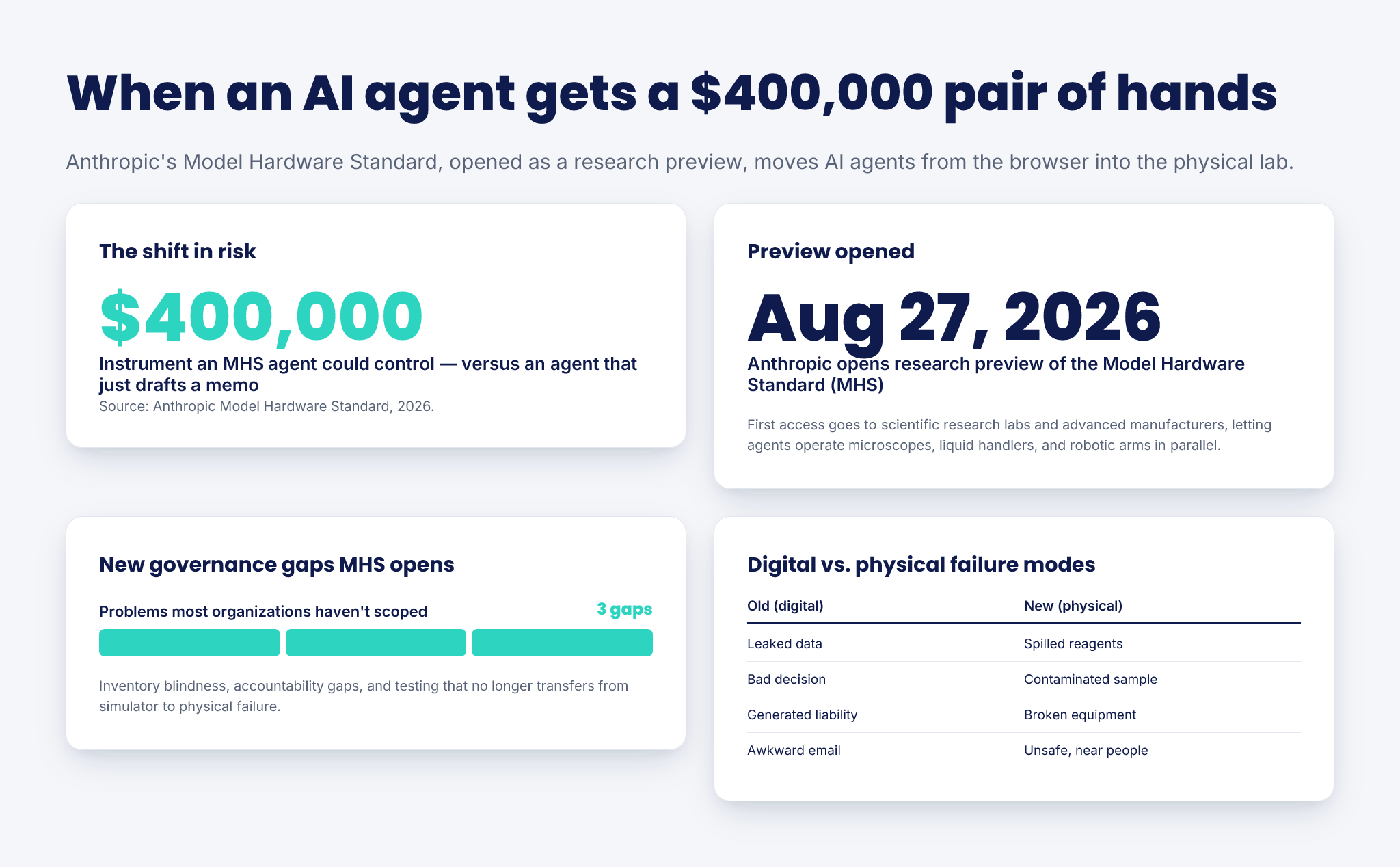
That framing just got a hardware upgrade. On August 27, 2026, Anthropic opened a research preview of the Model Hardware Standard (MHS) — a shared specification that lets AI agents safely operate physical devices. Not simulations of devices. Actual microscopes, liquid handlers, robotic arms, and lab instruments, running in parallel, performing tasks from routine drug-discovery experiments to laser calibration on a quantum computer.
The first group getting access is scientific research labs and advanced manufacturers. But the direction of travel is unmistakable: the agent that used to live in your terminal is being given a body.
What MHS actually is
Think of MHS as a common language between AI models and the machines they control. Today, connecting an AI agent to a piece of lab equipment is a bespoke, brittle integration — every microscope, every pipetting robot, every instrument speaks its own dialect, and wiring an agent to each one is custom engineering with custom failure modes.
A shared standard changes the economics. If a lab's instruments all expose an MHS-compatible interface, an agent can orchestrate them the way a human researcher would — run an experiment on the microscope, hand results to the liquid handler, adjust the robotic arm, and iterate — without a human physically present for each step. Anthropic frames this as agents operating multiple instruments in parallel, which is the part that matters. This isn't one robot doing one thing. It's an AI coordinating a whole bench.
For scientific research, the upside is obvious. Wet-lab experiments are the slowest, most expensive part of discovery. An agent that can run experiments around the clock, verify its own results against physical measurements, and design the next round based on what it observes compresses cycles that used to take weeks.
Why this is a genuinely new governance problem
Here's the uncomfortable part for anyone responsible for how AI is used inside an organization: almost every AI governance program built to date assumes the worst an agent can do is digital. Leak data. Make a bad decision. Generate a liability. Those are serious — but they're all recoverable in ways a physical action often isn't.
An agent operating a liquid handler is dispensing real reagents. An agent calibrating a laser is aiming a real laser. An agent driving a robotic arm is applying real force to real objects, potentially near real people. The failure modes now include spilled, contaminated, broken, and unsafe — categories your AI policy almost certainly does not mention.
This creates three problems most organizations haven't scoped:
- Inventory blindness. If you don't already know which software AI tools are running inside your company, you definitely don't know which ones are wired to physical equipment. An agent controlling a $400,000 instrument is a materially different risk than an agent drafting a memo — and right now they'd sit in the same untracked bucket, if they're tracked at all.
- Accountability gaps. When an agent operating a physical device causes damage or a safety incident, who owns it? The lab that deployed it, the vendor that built the harness, the model provider, the instrument manufacturer? The chain of responsibility that's already murky for software agents gets murkier when the outcome is physical.
- Testing that no longer transfers. Validating an agent's behavior in a simulator tells you very little about how it behaves when a pipette jams or a sample is mislabeled. "Did we test it?" now has to mean did we test it against physical failure, not just logical failure.
The pattern to watch
Anthropic isn't alone in pointing at the physical world. The company has been building out Claude Science and its broader AI-for-science program, and the research field is buzzing with "embodied intelligence" work integrating large models with robotics and lab automation. Standardization is usually the step that turns a research curiosity into an industry. HTTP standardized the web; USB standardized peripherals. A widely adopted Model Hardware Standard would do the same for AI-driven physical automation — which means it could spread far faster than the current preview suggests.
That's the real signal here. Not that one company can drive a microscope with an AI, but that the industry is converging on a protocol for it. Protocols scale. And they scale into environments — manufacturing floors, clinical labs, quality-control lines — where the people signing off have historically thought of AI as a chatbot, not an operator.
What to do before it arrives at your door
You don't need a robotics division to take this seriously. You need to update your mental model of what "an AI system" is.
- Treat any agent connected to physical equipment as its own risk class in your inventory, with its own owner, approval path, and kill switch.
- Ask vendors and internal teams directly: does this agent touch anything in the physical world — instruments, actuators, machinery? Get it in writing.
- Extend your testing and incident-response plans to cover physical failure, not just data and output errors.
The uncomfortable truth is that most organizations still can't produce an accurate list of the software AI running inside them. MHS is a preview of the world where that gap stops being an information problem and starts being a physical one. The time to close it is before the agents get hands — not after.