

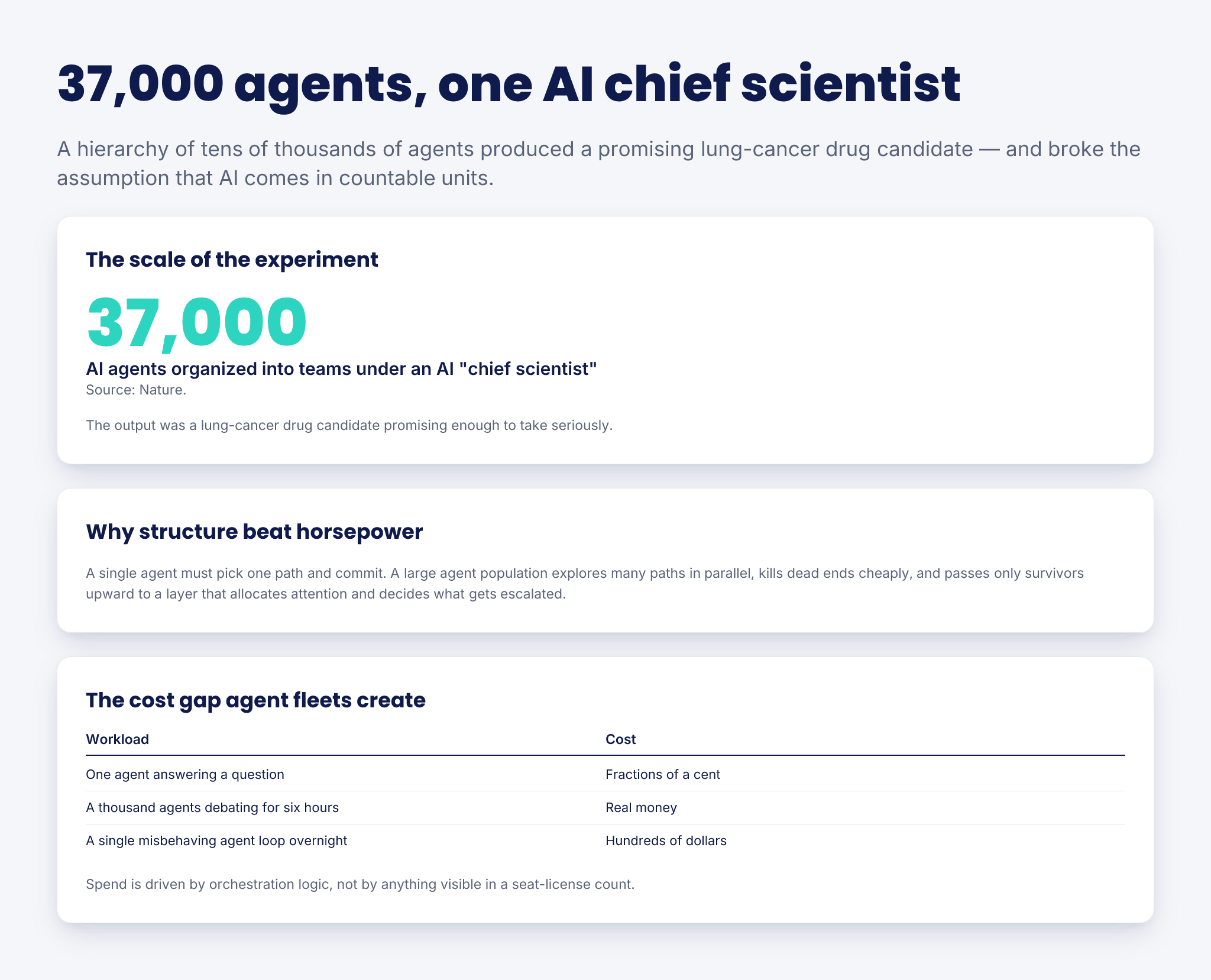
Researchers built a "virtual biotech" of up to 37,000 AI agents under an AI chief scientist — and it surfaced a promising lung-cancer drug.
Nature reports that a research team assembled something that looks less like a tool and more like a company: tens of thousands of AI agents, organized into teams, reporting up through an agent acting as "chief scientist." The output wasn't a slide deck. It was a lung-cancer drug candidate that looks promising enough to take seriously.
Set aside the drug for a moment. The interesting part is the org chart.
For two years, the default mental model of an AI agent has been one agent: a single assistant with tools, a prompt, and a loop. Every governance conversation, every procurement review, every budget line assumed that shape. What this experiment demonstrates is a different shape entirely — a hierarchy of agents where the meaningful unit of work isn't a model call but an institution made of model calls.
Why scale changed the result
The reason a team of 37,000 agents beats one very good agent isn't raw horsepower. It's structure.
Drug discovery is a search problem with a brutal ratio: thousands of plausible directions, almost all of them dead ends. A single agent has to pick one path and commit. A large agent population can explore many paths in parallel, kill the bad ones cheaply, and pass only the survivors upward. The "chief scientist" layer does what a human research director does — allocate attention, reconcile conflicting findings, decide what gets escalated.
That's not a smarter model. It's a better division of labor. And it maps uncomfortably well onto how actual firms produce knowledge: hierarchy exists because judgment is scarce and needs to be concentrated where it matters most.
Which raises the question every operator should be sitting with: if the winning configuration of AI is organizational, then the thing you're adopting isn't software. It's headcount that doesn't appear in any HR system.
The honest caveats
Two things are worth naming before anyone reorganizes around this.
First, this is one result in a domain that is unusually friendly to brute-force search. Molecular design has simulable intermediate steps and objective scoring functions. Most business processes do not. You cannot run 37,000 parallel attempts at a customer negotiation or a hiring decision and score them cheaply.
Second, a promising candidate is not a drug. The gap between "this molecule looks good" and "this molecule works in humans without hurting them" is measured in years and hundreds of millions of dollars. The AI did the part of the pipeline that is fast and cheap. The slow, expensive part is still slow and expensive.
But the caveat cuts both ways. The reason this is newsworthy isn't that AI replaced pharmacologists. It's that scale of coordination turned out to be a lever nobody was pulling. And unlike model quality, coordination is something enterprises can experiment with immediately, using models they already have.
What breaks when agents multiply
Here's where this stops being a science story and becomes an adoption story.
Almost every system companies use to track AI assumes a countable number of named tools. A vendor list. A model registry. A handful of approved assistants with owners attached. That assumption survives about five minutes of contact with agent fleets.
- Spend becomes non-linear and non-obvious. One agent answering a question costs fractions of a cent. A thousand agents debating each other for six hours costs real money, and the cost is driven by the orchestration logic, not by anything a finance team can see in a seat-license count. Teams are already discovering this the hard way — a single misbehaving agent loop that burns hundreds of dollars overnight is now an ordinary occurrence.
- Inventory shifts from tools to topologies. The right question stops being "which models do we use?" and becomes "what agent structures are running, who designed them, and what can they reach?" A fleet is defined by its wiring: which agents can spawn others, which have tool access, which can write to production systems, where the escalation path terminates in a human.
- Accountability gets diffuse fast. When an output emerges from 37,000 agents and a synthetic manager, "who decided this?" has no clean answer. That is survivable in a research setting where every claim gets validated downstream in a wet lab. It is not survivable in a setting where the agent's output is the decision.
The practical read
You do not need 37,000 agents. You almost certainly should not build 37,000 agents. But you should update three things.
- Treat agent architecture as a governed design choice. How many agents, how deep the hierarchy, what each layer is allowed to do — these are decisions with cost and risk attached, and right now they're usually made by whoever wrote the code.
- Instrument spend at the workflow level, not the tool level. Per-seat and per-vendor views will systematically understate agentic workloads. You want cost attributable to a business process.
- Insist on a validation layer. The virtual biotech worked partly because its output faced an external reality check. Agent fleets without one are confidence machines.
The uncomfortable implication of this result is that AI capability is no longer only something you buy from a lab. Increasingly, it's something you organize — and organizational design has always been where companies differentiate, and where they quietly fail.
If you can't currently answer how many agents are running inside your organization, what they cost, and who owns them, that's the gap worth closing before the next model release makes it bigger.