

a16z's latest consumer AI data shows usage and spend concentrating in a handful of apps — a pattern that quietly explains why most enterprise AI pilots never scale.
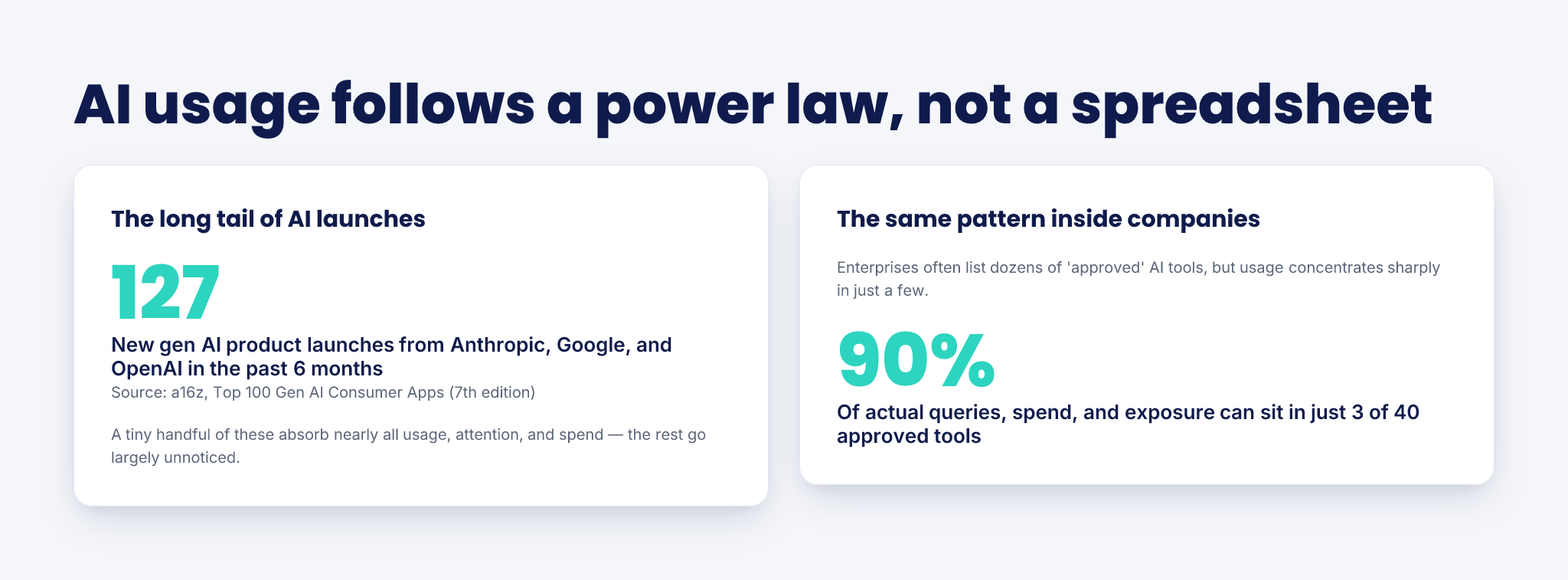
Andreessen Horowitz just published its seventh "Top 100 Gen AI Consumer Apps" report, and buried in the usual leaderboard is a number worth sitting with: across Anthropic, Google, and OpenAI alone, there were 127 new product launches in the past six months. Most of them you have never heard of. A tiny handful — the ones that make the top of the list — absorb nearly all the usage, nearly all the attention, and, increasingly, nearly all the spend.
This isn't a consumer-app curiosity. It's a preview of exactly what's happening inside your own organization right now, just with company names instead of app names.
The pattern repeats at every scale
Walk into any mid-size or large company today and ask how many AI tools are "in use." You'll get a number that undercounts reality — but even the honest, generous count tends to show the same shape a16z found in the consumer market: a small number of tools (usually one chat assistant, one coding copilot, maybe one vertical tool a single team champions) account for the overwhelming majority of actual usage. Everything else is a trial account, a Slack integration nobody opened twice, a line item from a vendor demo that went nowhere.
That's not a failure of discipline. It's the natural result of how adoption actually works. People gravitate to the tool that's good enough, already open in a browser tab, and doesn't require relearning a workflow. Usage compounds toward winners the same way attention does in consumer markets — and the tools that don't win that early battle don't fail loudly. They just fade into unused licenses and forgotten pilots.
Why this matters more than the leaderboard suggests
The consumer story is interesting because of what it implies for the enterprise one. If AI usage reliably follows a power law — a few tools capturing almost everything, a long tail capturing almost nothing — then two things follow for anyone trying to manage AI responsibly inside a company:
First, your inventory is lying to you if it treats every tool as equally important. A list of 40 approved AI systems looks thorough. But if three of them account for 90% of actual queries, spend, and exposure, then your governance effort, your monitoring, and your incident-response planning should be weighted the same way your usage is — not spread evenly across a spreadsheet where a one-off pilot gets the same scrutiny as the tool your entire sales org touches daily.
Second, procurement and shadow AI are two sides of the same curve. The long tail of 127 launches a16z counted isn't noise — it's the same mechanism that produces shadow AI inside enterprises. Teams try things. Most don't stick. A few quietly become load-bearing. The problem is that "quietly become load-bearing" is exactly the phase where nobody goes back and asks whether the tool was ever properly vetted, whether its data handling was ever reviewed, or whether anyone outside the team that adopted it even knows it's there.
What good AI management actually looks like
The instinct in a lot of organizations is to try to govern everything equally — a blanket policy, a universal approval process, the same five-dimension checklist applied to a trial account and a company-wide deployment. That instinct is well-intentioned and it's also why so many governance programs collapse under their own weight within a year. Nobody can sustain uniform rigor across a hundred tools when ninety of them barely get used.
The more durable approach mirrors what the usage data itself is telling you: find out where the actual concentration lives, then govern in proportion to it. That requires actually knowing, continuously, which systems are carrying the weight — not which ones were approved eighteen months ago, not which ones show up in a procurement log, but which ones people are using today, how much they cost, and what they touch. A tool that quietly went from "someone's experiment" to "half the company's daily workflow" deserves security review, cost scrutiny, and a maturity assessment far more urgently than the dozen tools sitting untouched in a license list.
This is also a useful corrective for anyone building an AI roadmap off hype cycles. The 127-launches number is a reminder that most AI products, even from the best-funded labs in the world, don't win meaningful usage. Betting your strategy on being an early adopter of the newest release is a weaker move than building the discipline to notice, early, when a tool you already have is becoming the one that matters — and acting on that signal before the gap between "in use" and "understood" becomes the thing that gets you in trouble.
The consumer AI market is showing its hand: usage concentrates, fast, and unevenly. The organizations that treat their own AI footprint the same way — tracking where the real weight sits rather than where the approval paperwork sits — will spend their governance effort where it actually counts.