

OpenAI says it's building agents with "ongoing responsibilities" — a shift from task-bound AI to persistent AI that raises a question most companies can't yet answer: who's watching it in month three?
Most of the AI agents inside your organization today have a shape you can reason about. Someone gives it a task. It runs. It finishes, fails, or gets interrupted. There's a start and an end, and in between, a human is usually one click away from checking in.
At its 2026 DevDay, OpenAI signaled a shift away from that shape. In its own recap of the event, the company says it introduced "agents that can take on ongoing responsibilities" — language that, on its face, describes something categorically different from a chatbot answering a question or a coding agent finishing a pull request. An agent with an ongoing responsibility doesn't have a natural stopping point. It keeps running, keeps deciding, keeps acting — indefinitely, or until someone notices it and turns it off.
That's a meaningful change, and worth taking seriously even though OpenAI's own public description of it is still thin. We don't know the exact release date of this capability, how widely it's been rolled out, or the technical details of how these agents are built, permissioned, or supervised day to day. What we do know is the direction: at least one major lab is explicitly positioning its agents as things that take on standing responsibilities, not just tasks — and if that framing holds, it changes what "having an AI agent" means for the people who have to govern it.
Task-bound vs. ongoing is a real distinction
It's worth being precise about why this matters, because "agent" has become a word that covers everything from a weekend hobby project to a six-figure enterprise deployment.
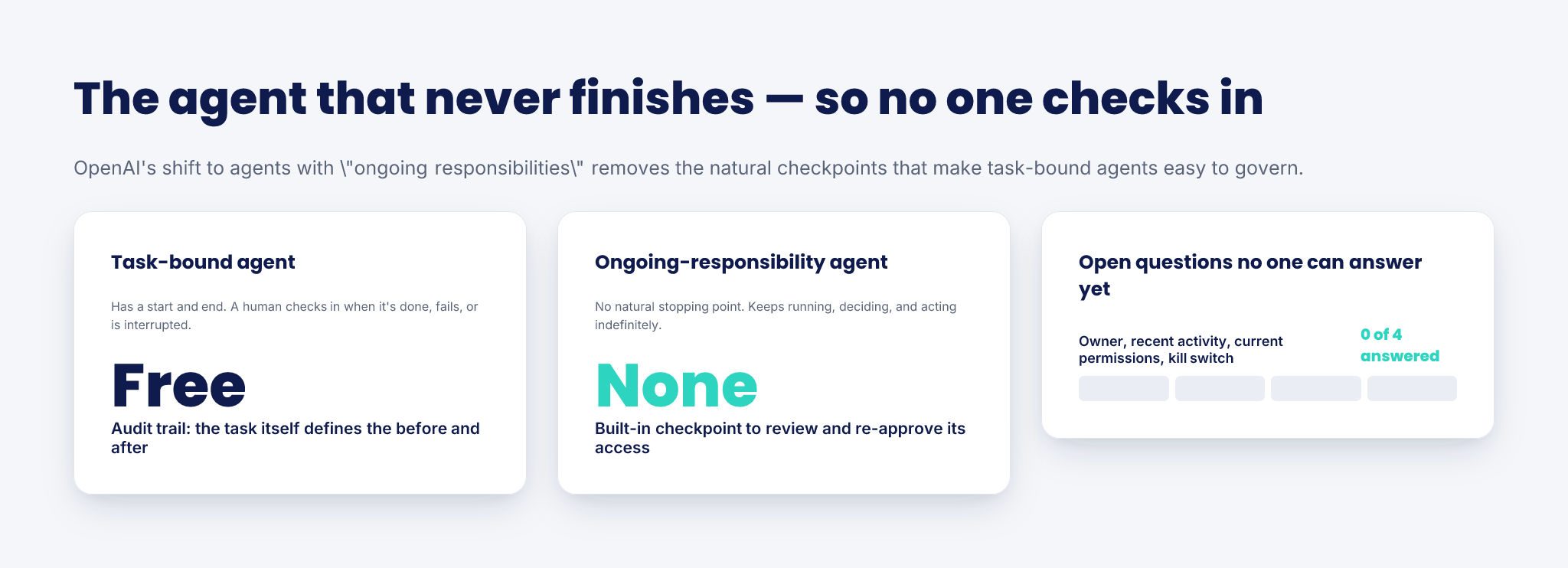
A task-bound agent is easy to reason about because it's easy to bound. You know what it was asked to do, you can check whether it did it, and when it's done, it's done. The audit trail is basically free: the task defines the before and after.
An agent with an ongoing responsibility doesn't offer that boundary for free. If an agent is tasked with, say, continuously monitoring a queue, triaging incoming requests, or maintaining some system over time, there's no natural checkpoint where someone reviews what it did and decides whether to let it keep going. It just keeps going — accumulating decisions, accumulating access, accumulating the kind of quiet authority that's easy to grant and hard to claw back.
The honest list of open questions
We don't have confirmed answers to these yet — not from OpenAI's materials, and not from how organizations are actually using this kind of capability in practice. But they're the questions any team evaluating a persistent agent should be asking before granting one standing access to anything:
- Who owns it after the person who set it up moves on or forgets about it? A task has a requester. An ongoing responsibility needs an owner — someone accountable for it existing at all, not just for the outcome of one run.
- How do you know what it's done lately, not just what it was built to do? A task-bound agent's behavior is implicitly documented by its output. A standing agent's behavior over the last month may not be visible anywhere unless someone built logging for it on purpose.
- What permissions does it hold, and do they still make sense? Access granted to get a job started is easy to approve. Access held indefinitely is a different risk calculus, and few organizations re-review it on any schedule.
- What's the kill switch, and does anyone know where it is? Turning off a task is trivial — it finishes or you cancel it. Turning off a standing responsibility means someone has to notice it, decide it should stop, and know how.
None of these are hypothetical concerns specific to any one vendor's product. They're the natural consequence of agents moving from "does a thing" to "is responsible for a thing" — a shift that, if OpenAI's framing is representative of where the industry is heading, enterprises should expect to see more of across tools they already use, not less.
Inventory has to include duration, not just function
Most AI inventories ask what a system does and who approved it. Very few ask how long it's expected to keep operating, or whether anyone revisits that question on a cadence. That's a gap task-bound agents could mostly paper over — the task itself was the review cycle. Ongoing agents remove that safety net.
If your organization is evaluating or already running any agent described as having a standing role rather than a one-off job — monitoring something, maintaining something, handling a class of requests indefinitely — the least you should be able to answer is: who owns it, what can it touch right now, and when was that last checked. If those questions don't have quick answers, the agent isn't the risk yet. The not-knowing is.
The capability described at DevDay may turn out to be narrow, experimental, or slow to spread. But the direction — agents built to keep working rather than finish and stop — is one every enterprise AI inventory should be ready for before it shows up as a surprise rather than a line item.